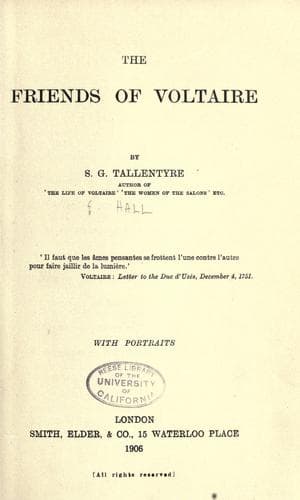
France -- Biography; Voltaire, 1694-1778 -- Friends and associates
Voltaire, now retired to Cirey, science, and Madame du Châtelet, had
made poetry the fashion. I too will be a poet! The young Farmer-General
racked his sharp brains a little, and as a result sent Voltaire some
long, dismal cantos on ‘Happiness.’ The master replied with the
kindliest criticism, and offered advice so keen and excellent that if
poets were made, not born, Helvétius’ verses might still live. But,
after all, advice by post is always unsatisfactory. Helvétius’
Farmer-Generalship made periodical tours in the provinces an agreeable
necessity. On a journey through Champagne, what more natural than to
stop awhile at Cirey, where Voltaire was writing ‘Mahomet,’ and Madame
du Châtelet was the most delightful of blue-stocking hostesses? Between
Arouet of five-and-forty and Claude-Adrien of five-and-twenty a warm
friendship was cemented. All Voltaire’s correspondence from 1738 until
1771 is studded with letters to Helvétius. The young man was his ‘very
dear child,’ ‘my rival, my poet, my philosopher.’ If he took so large
and liberal a view of Helvétius’ talents as to declare that, as a poet,
he had as much imagination as Milton, only more smoothness and
regularity (!), yet he was not afraid to wrap up the pill of many a
shrewd home truth in the fine sugar-plums of compliments.
But, after all, _is_ poetry the easiest way to glory? Claude-Adrien,
returned to Paris, walking through the Tuileries gardens one day, saw
the hideous Maupertuis, the geometrician, surrounded by all the charming
and pretty women, adoring him, and immediately decided to abandon verse
and be a geometrician instead. But before he had taken a couple of steps
in this direction, the publication of the ‘Spirit of Laws’ in 1748
electrified Europe, and changed his mind. To be sure, when, three years
earlier, Montesquieu had brought the book up to Paris and asked the
young Farmer-General’s judgment on it, Helvétius had replied that it was
altogether unworthy of the author of the ‘Persian Letters,’ and had
strongly recommended him not to publish it. Well, that advice can be
conveniently forgotten. Helvétius paid Montesquieu the sincerest of all
flattery by resolving on the spot to be a philosopher himself.
If, between these eventful years of three-and-twenty and six-and-thirty,
Helvétius had been nothing but an astute, ambitious young
man-about-town, seeking the likeliest way to fame and fortune, he would
have been undistinguishable from hundreds of others around him, and not
worth distinguishing. But, at his worst, there was something in him
which was never in that selfish crowd which thronged the galleries of
Versailles.
Public-domain text, read in full here on John Shaqi.
Reviews
Reviews
No reviews yet
Be the first to share your thoughts on this work.
Elsewhere in the archive
Join the Discussion
Join the discussion
Sign in to leave a comment or review.
Sign InorCreate an account