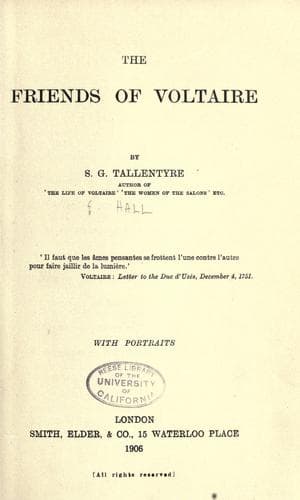
France -- Biography; Voltaire, 1694-1778 -- Friends and associates
In 1747, Madame de Graffigny attained celebrity by her ‘Letters from a
Peruvian.’ Turgot did her the honour of criticising them: frequented her
_salon_, which rapidly became famous, and at which, in 1750, Helvétius,
still young, rich, agreeable, and unmarried, became a constant visitor.
For a year, he was there perpetually. ‘The sheepfold of _bel esprit_,’
people called it. Helvétius liked to be thought a _bel esprit_, and it
was _de rigueur_ to admire the hostess’s ‘Peruvian’ and her play
‘Cénie,’ which was produced in 1750. He soon came to admire something
besides her writings. ‘Minette,’ as she nicknamed her niece, was such a
woman as fashionable eighteenth-century society rarely produced--such a
woman as any fashionable society rarely produces. Strong in mind and
body, good, straightforward and serene, refreshingly unconventional in
an age which had no god but the _convenances_, not half so clever as
that accomplished old fool, her aunt, and a hundred times more
sensible--such was Mademoiselle de Ligniville.
Helvétius studied her in his calm manner for a year, and at the end of
it proposed to her. Then he resigned his Farmer-Generalship with its
rich income; bought, to pacify his father, the post of _maître d’hôtel_
to Queen Marie Leczinska, and the estates of Voré and Lumigny in
Burgundy, and, on June 17, 1751, married Mademoiselle de Ligniville, who
was a Countess of the Holy Roman Empire, satisfactorily connected with
the nobility, and had not a single franc to her _dot_.
All these actions caused something very like consternation in the world
in which Helvétius lived. Give up a Farmer-Generalship! The man must be
mad! ‘So you are not insatiable, then, like the rest of them?’ says
Machault, the Controller-General. As to the estates in Burgundy, one
might as well be buried alive at once! While to marry a woman who is by
now certainly not a day less than two-and-thirty, has not an écu, and
has a tribe of hungry brothers and sisters clinging to her, as it were,
is certainly not the act of a sane person! Followed by the mingled pity
and contempt of all Paris, Helvétius and his wife left immediately for
Voré, and settled down to the eight happiest years of their lives.
Voré was one of those country estates which would still be called dull.
In those days, before railways, with a starving peasantry at its gates,
with rare posts of the most erratic description, and with the vilest
impassable roads between one country house and another, it might have
been called not merely dull, but dismal. But, after all, happiness is
what one is, not where one is. Perfectly content with each other, the
Helvétius would have been contented in a wilderness. Minette, says a
biographer, asked nothing better than to adore her husband and
perpetually to sacrifice herself to him.
Public-domain text, read in full here on John Shaqi.
Reviews
Reviews
No reviews yet
Be the first to share your thoughts on this work.
Elsewhere in the archive
Join the Discussion
Join the discussion
Sign in to leave a comment or review.
Sign InorCreate an account