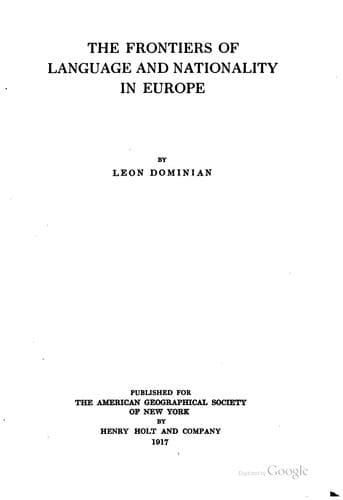
The Frontiers of Language and Nationality in EuropeDominian, Leon
History
The Frontiers of Language and Nationality in Europe
Dominian, Leon
Europe -- Languages; Nationalism
Poland’s easterly expansion with its prolonged and finally
disastrous conflicts with Russia began after the battle of Grunwald
in 1410. Although the Poles then inflicted a decisive defeat on the
Teutonic Knights, the western provinces they had lost could not
be regained. In the eastern field the basin of the Dnieper merged
without abrupt transition into that of the Vistula, just as the
basin of the Oder on the west formed the western continuation of
the Baltic plain. Four centuries of struggle with Russia ensued
until the Muscovite Empire absorbed the greater portion of Poland.
The German element is slowly spreading eastward throughout the
eastern provinces of Prussia which once formed part of the kingdom
of Poland. Emigration of Poles to central and western Germany
partly accounts for the German gain. From the larger cities of
eastern Germany and more especially from Posen, Bromberg and
Danzig, a steady stream of emigrants make their way towards the
industrial centers of the west, where they find higher wages and
generally improved economic conditions. The German government
favors this expatriation of its Slav subjects. None of the
vexations to which the Poles are subjected by government officials
on their native plains are tolerated in the occidental provinces
of the Empire. The result is that notable colonies of Poles have
sprung up in the vicinity of industrial centers like Düsseldorf or
Arnsberg, in the Munster district and the Rhine provinces. From a
racial standpoint, these Poles are practically indistinguishable
from Teutonic types. Their presence in Rhenish Prussia and
Westphalia is no menace to German unity. They are easily
assimilated; the second generation, speaking only German, forgets
its antecedents and becomes submerged in the mass of the native
population. Slav settlements are particularly numerous and dense
along the Rhine-Herne canal between Duisburg and Dortmund.[110]
They abound in the coal-producing Emscher valley, where their
inhabitants form one-fifth of the population. The Polish settlers
favor the flatlands and occupy them in preference to hilly regions.
They do not confine their work to mining, but provide labor for
the industrial plants clustered around the coal-fields. In the
beginning of 1911 the number of Polish miners in the 19 mining
districts of the “circle” of Dortmund exceeded that of any other
nationality.
Public-domain text, read in full here on John Shaqi.
Reviews
Reviews
No reviews yet
Be the first to share your thoughts on this work.
Elsewhere in the archive
Join the Discussion
Join the discussion
Sign in to leave a comment or review.
Sign InorCreate an account