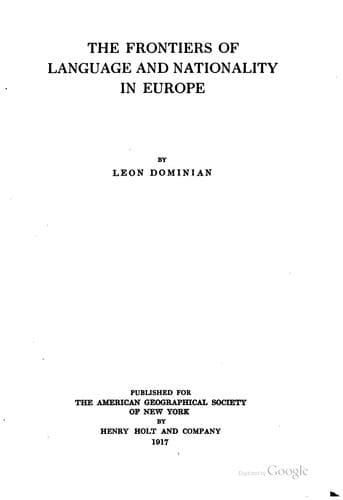
The Frontiers of Language and Nationality in EuropeDominian, Leon
History
The Frontiers of Language and Nationality in Europe
Dominian, Leon
Europe -- Languages; Nationalism
[276] R. von Pfaundler: Österreichisch-italienische Grenzfragen,
_Pet. Mitt._, Vol. 61, 1915, pp. 217-223.
[277] B. C. Wallis: Distribution of Nationalities in Hungary,
_Geogr. Journ._, Vol. 52, 1916, No. 3, pp. 177-189.
[278] Loc. cit.
APPENDIX A
GERMAN SETTLEMENTS IN RUSSIA
Colonies of Germans in Russia are found mainly in the Baltic
provinces and around the banks of the Volga. According to the
census of 1897 the German residents of the governments of Livonia,
Kurland, Esthonia and St. Petersburg numbered 229,084. The majority
of this northern element is distributed along the shores of the
Gulf of Riga.
The banks of the Volga were first colonized by Germans in 1763
after a proclamation issued by Empress Catherine II inviting
foreigners to settle on either side of the river in the environs
of Saratoff and Samara and as far as Tzaritzin. The distress
that followed the Seven Years’ War in Germany determined a
number of families of the afflicted provinces to seek a better
lot on Russian soil. By the year 1768 there had been founded
102 German settlements containing a total population of 27,000
inhabitants.[279] The newcomers had to face considerable hardships.
Many of them were neither farmers nor peasants. Their endurance was
taxed by the rigor of the climate. Insecurity of life and property
prevailed as badly as in their devastated motherland. In 1774
rebel bands led by Jemelian Pontgatcheff wrought havoc and ruin in
the new districts. Two years later hordes of Kirghiz nomads laid
waste the land again and carried off a number of the emigrants as
slaves. This state of affairs lasted until the last decades of the
nineteenth century. The Tatar raiders were attracted mainly by the
cattle of the colonists. The value of horses, camels and cattle
stolen between 1875 and 1882 is estimated at 330,000 rubles.[280]
It is estimated that fully five million rubles were spent by
the Russian government to plant these foreign colonies. But no
onerous terms were imposed on the settlers. A head tax of three
rubles constituted their only pecuniary obligation to the state.
Furthermore, a liberal administration was provided for their
settlements. Each village was ruled by an assembly recruited from
among its inhabitants.
Unfortunately for the development of these communities the Russian
system of collective ownership known as the “mir” was instituted.
Under this form of tenure all land becomes the property of the
village. Each male inhabitant is temporarily entitled to a share
of the whole area and an exchange of plots is made every ten
years. Each village then receives a new fraction and fresh lots
are apportioned to those who have come of age during the decade.
This method of ownership does not lead to development and generally
retards rather than promotes agricultural progress.
Public-domain text, read in full here on John Shaqi.
Reviews
Reviews
No reviews yet
Be the first to share your thoughts on this work.
Elsewhere in the archive
Join the Discussion
Join the discussion
Sign in to leave a comment or review.
Sign InorCreate an account