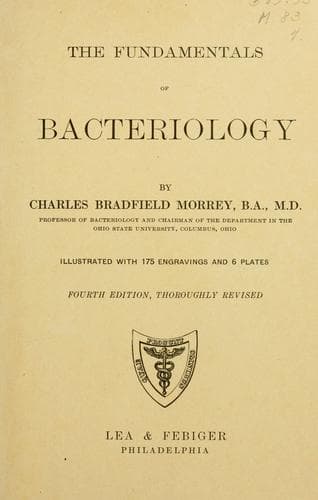
The Fundamentals of BacteriologyMorrey, Charles Bradfield
Science
The Fundamentals of Bacteriology
Morrey, Charles Bradfield
Bacteriology
Sat. alcoholic solution of methylene blue 1.0 part
Glacial acetic acid 2.5 parts
Distilled water 50.0 parts
_Bismarck Brown_:
Bismarck brown (dry dye) 2 parts
Distilled Water 1000 parts
By the use of the hanging drop slide and the methods of staining just
described all the various morphological features of the bacterial cell
may be ascertained.
It is necessary when _cell groupings_ as characteristic of definite
modes of division are to be determined to make slides from a liquid
culture, as broth. Place a drop of the material, preferably from the
bottom of the tube in most instances, from the top in case a pellicle
or scum is formed on the surface, on the slide and allow this to dry
_without spreading it out_, fix, wash gently with water, then stain
lightly with Löffler’s blue. Such slides also show characteristic
_cell forms_ as well. Slides should be made from solid media to show
variations in form and size and involution forms. These latter are
especially apt to occur on potato media.
CHAPTER XX.
STUDY OF THE PHYSIOLOGY OF BACTERIA.
Of the environmental conditions influencing the growth of bacteria the
following are the chief ones ordinarily determined:
_A._ Temperature.--The optimum temperature for growth is usually
about the temperature of the natural environment and ordinarily one
determines merely whether the organism grows at body temperature (37°)
and at room temperature (20°) or not. For exact work the maximum,
minimum and optimum temperature must be ascertained by growing in
“incubators” with varying temperatures.
A bacteriological incubator is an apparatus for growing bacteria at a
constant temperature. This may be any temperature within the limits for
bacterial growth. If temperatures above that of an ordinary room are
desired, some source of artificial heat is needed. Electricity, gas or
oil may be used. A necessary adjunct is some device for maintaining
the temperature constant, a “thermoregulator” or “thermostat.” For
lower temperatures a cooling arrangement must be installed. For the
great part of bacteriological work only two temperatures are used, 20°
so-called “room temperature” (this applies to European “rooms” not to
American) and 37° or body temperature. Incubators for 37° of almost any
size and style desired may be secured from supply houses and need not
be further described. Figs. 141 and 142 illustrate some of the types.
For use with large classes “incubator rooms” are to be preferred. The
author has one such room for 37° work with 200 compartments for student
use which did not cost over $60 to install.
[Illustration: FIG. 141.--Small laboratory incubator, gas heated.]
[Illustration: FIG. 142.--Electric incubator.]
Public-domain text, read in full here on John Shaqi.
Reviews
Reviews
No reviews yet
Be the first to share your thoughts on this work.
Elsewhere in the archive
Join the Discussion
Join the discussion
Sign in to leave a comment or review.
Sign InorCreate an account