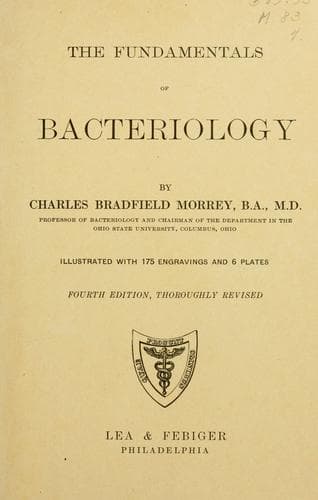
The Fundamentals of BacteriologyMorrey, Charles Bradfield
Science
The Fundamentals of Bacteriology
Morrey, Charles Bradfield
Bacteriology
Since a bacteriological diagnosis depends most commonly on growing the
organisms, it is evident that material sent for examination must _never
be treated with an antiseptic or preservative_. If decomposition is to
be feared the only safe procedure is to _pack the material in ice_ and
forward in this way.
_Tuberculous material from the parenchyma_ of internal organs may be
forwarded in a preservative (not _formalin_, since this makes it very
difficult to stain the bacteria) as _in this special_ case a very
positive diagnosis may be made by staining alone. Even here it is
better to _pack in ice_ in order that the diagnosis by staining may be
confirmed by inoculating the living organisms into guinea-pigs.
In the case of material _from a rabid animal_ and many protozoal
diseases the rule against preservatives is not absolute, since staining
is a reliable diagnostic means. Even in these cases it is often
desirable to inoculate animals, hence, as before stated, it is best to
make it a uniform practice to _pack material for examination in ice and
use no preservatives_.
PART IV.
GENERAL PATHOGENIC BACTERIOLOGY.
CHAPTER XXII.
INTRODUCTION.
Pathogenic Bacteriology treats of the unicellular microörganisms which
are responsible for disease conditions, _i.e._, pathological changes
in other organisms. Hence not only are bacteria considered, but also
other low vegetable forms, as yeasts and molds, likewise protozoa in
so far as they may be pathogenic. For this reason the term pathogenic
“Microbiology” has been introduced to include all these organisms. It
is largely for the reason that the methods devised for the study of
bacteria have been applied to the investigation of other microörganisms
that the term “bacteriology” was extended to cover the entire field.
The general discussion in this chapter is intended to include,
therefore, microörganisms of whatever kind pathogenic to animals.
The term pathogenic as applied to an organism must be understood in a
purely _relative_ sense, since there is no single organism that can
cause disease in all of a certain class, but each is limited to a more
or less narrow range. Some form of tuberculosis attacks nearly all
vertebrates, but no other classes of animals and no plants. Lockjaw or
tetanus attacks most mammals, but not any other vertebrates naturally.
Typhoid fever affects human beings; hog cholera, swine, etc. This point
is more fully discussed in Chapter XXIII but can not be too greatly
insisted upon.
“The greatest enemy to mankind is man.”
Exceptions to this statement do occur and are important and must be
considered in efforts to protect completely human beings from disease
(tuberculosis from cattle, glanders from horses, poisoning from spoiled
canned goods, anthrax from hair, hides, wool, of animals dead of the
disease), but the most common human diseases are derived from other
human beings directly or indirectly.
Public-domain text, read in full here on John Shaqi.
Reviews
Reviews
No reviews yet
Be the first to share your thoughts on this work.
Elsewhere in the archive
Join the Discussion
Join the discussion
Sign in to leave a comment or review.
Sign InorCreate an account