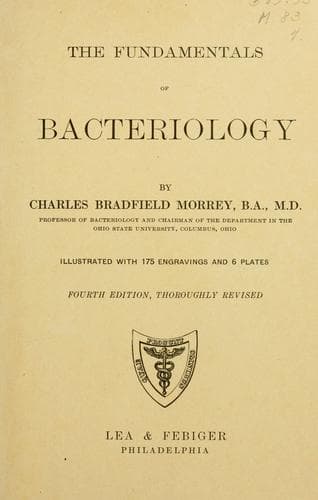
The Fundamentals of BacteriologyMorrey, Charles Bradfield
Science
The Fundamentals of Bacteriology
Morrey, Charles Bradfield
Bacteriology
The differences between acute and chronic infections are partly due
to the nature of the organism, partly to the number of organisms
introduced and the point of their introduction and partly to the
resistance of the animal infected.
An infectious disease is said to be _specific_ when one kind of
organism is responsible for its manifestations--as diphtheria due
to the _Corynebacterium diphtheriæ_, lockjaw due to _Clostridium
tetani_, Texas fever due to the _Piroplasma bigeminum_, etc. It is
_non-specific_ when it may be due to a variety of organisms, as
_enteritis_ (generally), _bronchopneumonia_, _wound infections_.
Henle, as early as 1840, stated certain principles that must be
established before a given organism can be accepted as the cause of a
specific disease. These were afterward restated by Koch, and have come
to be known as “Koch’s postulates.” They may be stated as follows:
1. The given organism must be found in all cases of the disease in
question.
2. No other organism must be found in all cases.
3. The organism must, when obtained in pure culture, reproduce the
disease in susceptible animals.
4. It must be recovered from such animals in pure culture and this
culture likewise reproduce the disease.
These postulates have not been fully met with reference to any disease,
but the principles embodied have been applied as far as possible
in all those infections which we recognize as specific, and whose
causative agent is accepted. In many diseases recognized as infectious
and contagious no organism has been found which is regarded as the
specific cause. In some of these the organism appears to be too small
to be seen with the highest powers of the microscope, hence they are
called “_ultramicroscopic_” organisms. Because these agents pass
through the finest bacterial filters, they are also frequently called
“_filterable_.” The term “_virus_” or “_filterable virus_” is likewise
applied to these “ultramicroscopic” and “filterable” agents.
Public-domain text, read in full here on John Shaqi.
Reviews
Reviews
No reviews yet
Be the first to share your thoughts on this work.
Elsewhere in the archive
Join the Discussion
Join the discussion
Sign in to leave a comment or review.
Sign InorCreate an account