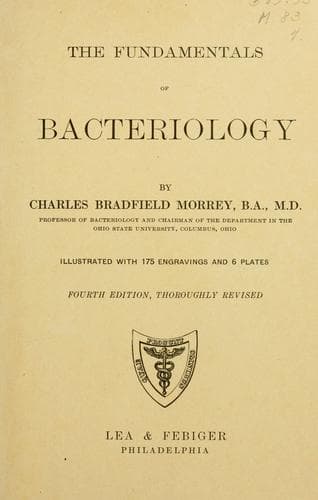
The Fundamentals of BacteriologyMorrey, Charles Bradfield
Science
The Fundamentals of Bacteriology
Morrey, Charles Bradfield
Bacteriology
(_a_) The most common infectious diseases of animals are transmitted
more or less directly from other animals of the same species. Human
beings get nearly all their diseases from other human beings who are
sick; horses, from other horses; cattle, from other cattle; swine,
from swine, etc. Occasionally transmission from one species to another
occurs. Tuberculosis of swine most frequently results from feeding
them milk of tuberculous cattle or from their eating the droppings of
such cattle. Human beings occasionally contract anthrax from wool,
hair and hides of animals dead of the disease or from postmortems
on such animals; glanders from horses; tuberculosis (in children)
from tuberculous milk; bubonic plague from rats; rabies practically
always from the bites of dogs and other rabid animals, etc. The
mode of limiting this class of diseases is evidently to isolate the
sick, disinfect their discharges and their _immediate_ surroundings,
sterilize such products as must be handled or used, kill lower animals
that are dangerous, and disinfect, bury properly, or destroy their
carcasses.
Classes of the sick that are especially dangerous for the spread of
disease are the mild cases and the undetected cases. These individuals
do not come under observation and hence not under control.
(_b_) This class of carriers offers a difficult problem in the
prevention of infectious diseases since they may continue to give off
the organisms indefinitely and thus infect others. Typhoid carriers
have been known to do so for fifty-five years. Cholera, diphtheria,
meningitis and other carriers are well known in human practice.
Carriers among animals have not been so frequently demonstrated,
but there is every reason for thinking that hog-cholera, distemper,
roup, influenza and other carriers are common. Carriers furnish the
explanation for many of the so-called “spontaneous” outbreaks of
disease among men and animals.
It is the general rule that those who are sick cease to carry the
organisms on recovery and it is the occasional ones who do not that are
the exceptions. In those diseases in which the organism is known it
can be determined by examination of the patient or his discharges how
long he continues to give off the causative agent. In those in which
the cause is unknown (in human beings, the commonest and most easily
transmitted diseases, scarlet fever, measles, German measles, mumps,
chicken-pox, small-pox, influenza), no such check is possible. It is
not known how long such individuals remain carriers. Hence isolation
and quarantine of such convalescents is based partly on experience
and partly on theory. It is highly probable that in the diseases just
mentioned transmission occurs in the _early stages only_, except
in small-pox and chicken-pox where the organism seems to be in the
pustules and transmission by means of material from these is possible,
though only by direct contact with it.
Public-domain text, read in full here on John Shaqi.
Reviews
Reviews
No reviews yet
Be the first to share your thoughts on this work.
Elsewhere in the archive
Join the Discussion
Join the discussion
Sign in to leave a comment or review.
Sign InorCreate an account