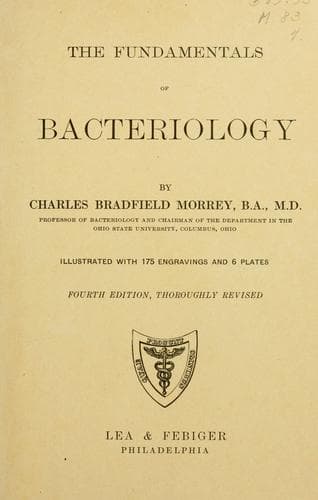
The Fundamentals of BacteriologyMorrey, Charles Bradfield
Science
The Fundamentals of Bacteriology
Morrey, Charles Bradfield
Bacteriology
tone” in all possible ways: The use of protective vaccines (Chap. XXX)
appears to be advisable in such instances (colds, pneumonia after
measles and influenza, inflammation of throat and middle ear following
scarlet fever and measles). Results obtained in this country during
the recent influenza epidemic have been conflicting but on the whole
appear to show that preventive vaccination against _pneumonia liable to
follow_ should be practiced.
It would seem that among groups of individuals where infection may be
expected the proper procedure would be to prepare autogenous vaccines
(Chapter XXX) from members of the group and vaccinate all with the
object of protecting them.
II. B.
(_d_) In this class come the “accidental carriers” like flies, fleas,
lice, bed-bugs, ticks, and other biting and blood-sucking insects,
vultures, buzzards, foxes, rats, and carrion-eating animals generally;
pet animals in the household, etc. Here the animals are not susceptible
to the given disease but become contaminated with the organisms
and then through defilement of the food or drink or contact with
individuals or with utensils pass the organisms on to the susceptible.
Some biting and blood-sucking insects transmit the organisms through
biting infected and non-infected animals successively. The spirilloses
and trypanosomiases seem to be transmitted in this way, though there
is evidence accumulating which may place these diseases in the next
class. Anthrax is considered in some instances to be transmitted by
flies and by vultures in the southern United States. Transmission
of typhoid, dysentery, cholera and other diseases by flies is well
established in man. Why not hog-cholera from farm to farm by flies,
English sparrows, pigeons feeding, or by turkey buzzards? Though this
would not be easy to prove, it seems reasonable.
Preventing contact of such animals with the discharges or with the
carcasses of those dead of the disease, destruction of insect carriers,
screening and prevention of fly breeding are obvious protective
measures.
(_e_) In this class come certain diseases for which particular
insects are necessary for the parasite in question, so that certain
stages in its life history may be passed therein. The surest means
for eradicating such diseases is the destruction of the insects
concerned. Up to the present no _bacterial_ disease is known in which
this condition exists, unless Rocky Mountain spotted fever and typhus
fever shall prove to be due to bacteria. Such diseases are all due to
protozoa. Among them are Texas fever, due to _Piroplasma bigeminum_
in this country which has been eradicated in entire districts by
destruction of the cattle tick (_Margaropus annulatus_).
Public-domain text, read in full here on John Shaqi.
Reviews
Reviews
No reviews yet
Be the first to share your thoughts on this work.
Elsewhere in the archive
Join the Discussion
Join the discussion
Sign in to leave a comment or review.
Sign InorCreate an account