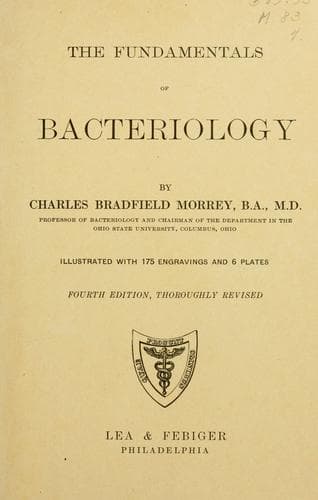
The Fundamentals of BacteriologyMorrey, Charles Bradfield
Science
The Fundamentals of Bacteriology
Morrey, Charles Bradfield
Bacteriology
(_a_) The external auditory meatus is rarely the seat even of local
infection. The tympanic cavity is normally sterile, though it may
become infected by extension through the Eustachian tube from the
pharynx (_otitis media_).
(_b_) The conjunctiva is frequently the seat of localized, very rarely
the point of entrance for a generalized infection, except after severe
injury. Those diseases whose path of entrance is generally assumed to
be the respiratory tract (see “Lungs” below) might also be admitted
through the eye. Material containing such organisms might get on the
conjunctiva and be washed down through the lachrymal canal into the
nose. Experiment has shown that bacteria may pass in this way in a
few minutes. In case masks are worn to avoid infection from patients
suffering with these diseases, the eyes should therefore be protected
as well as the nose and mouth.
(_c_) The nasal cavity on account of its anatomical structure retains
pathogenic organisms which give rise to local infections more
frequently than other mucosæ of its character. These may extend from
here to middle ear, neighboring sinuses, or along the lymph spaces of
the olfactory nerve into the cranial cavity (meningitis). Acute coryza
(“colds” in man) is characteristic. Glanders, occasionally, is primary
in the nose, as is probably roup in chickens, leprosy in man. The
meningococcus and the virus of poliomyelitis pass from the nose into
the cranial cavity without local lesions in the former.
(_d_) The mouth cavity is ordinarily protected by its epithelium
and secretions, though the injured mucosa is a common source of
_actinomycosis_ infection, as well as thrush. In foot-and-mouth disease
no visible lesions seem necessary to permit the localization of the
unknown infective agent.
(_e_) The tonsils afford a ready point of entrance for ever-present
_micrococci_ and _streptococci_ whenever occasion offers (follicular
tonsillitis, “quinsy”), and articular rheumatism is not an uncommon
sequel. The diphtheria bacillus characteristically seeks these
structures for its development. Tubercle and anthrax organisms
occasionally enter here.
(_f_) The pharynx is the seat of localized infection as in
_micrococcal_, _streptococcal_ and diphtherial “sore throat” in human
beings, but both it and the esophagus are rarely infected in animals
except as the result of injury.
(_g_) The external genitalia are the usual points of entrance for
the venereal organisms in man (gonococcus, _Treponema pallidum_, and
Ducrey’s bacillus). The bacillus of contagious abortion and probably
the trypanosome of dourine are commonly introduced through these
channels in animals.
Public-domain text, read in full here on John Shaqi.
Reviews
Reviews
No reviews yet
Be the first to share your thoughts on this work.
Elsewhere in the archive
Join the Discussion
Join the discussion
Sign in to leave a comment or review.
Sign InorCreate an account