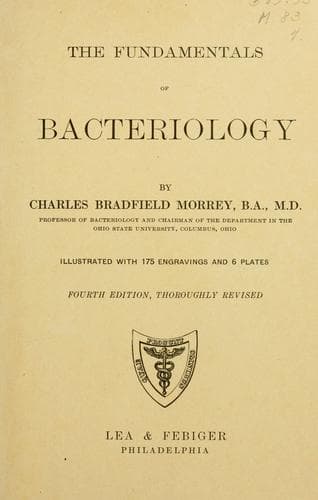
The Fundamentals of BacteriologyMorrey, Charles Bradfield
Science
The Fundamentals of Bacteriology
Morrey, Charles Bradfield
Bacteriology
Pasteur and the bacteriologists of his time discovered that bacteria
cease to grow in artificial culture media after a time, because of
the exhaustion of the food material in some cases and because of the
injurious action of their own products in other instances. These facts
were brought forward to explain immunity shortly after bacteria were
shown to be the cause of certain diseases. Theories based on these
observations were called (1) “_Exhaustion Theory_” of _Pasteur_, and
(2) “_Noxious Retention Theory_” of _Chauveau_ respectively. The fact,
soon discovered, that virulent pathogenic bacteria are not uncommonly
present in perfectly healthy animals, and the later discovery that
immunity may be conferred by the injection of dead bacteria have led
to the abandonment of both these older ideas. The (3) “_Unfavorable
Environment_” theory of _Baumgartner_, _i.e._, bacteria do not grow
in the body and produce disease because their surroundings are not
suitable, in a sense covers the whole ground, though it is not true as
to the first part, as was pointed out above, and is of no value as a
working basis, since it offers no explanation as to _what the factors
are_ that constitute the “_unfavorable environment_.” Metchnikoff
brought forward a rational explanation of immunity with his (4)
“_Cellular or Phagocytosis Theory_.” As first propounded it based
immunity on the observed fact that certain white blood corpuscles,
_phagocytes_, engulf and destroy bacteria. Metchnikoff has since
elaborated the original theory to explain facts of later discovery.
Ehrlich soon after published his (5) “_Chemical or Side-chain Theory_”
which seeks to explain immunity on the basis of _chemical substances_
in the body which may in part destroy pathogenic organisms or in
part neutralize their products; or in some instances there may be
an absence of certain chemical substances in the body cells so that
bacteria or their products _cannot unite_ with the cells and hence can
do no damage.
[Illustration: PLATE VI
PAUL EHRLICH]
At the present time it is generally accepted, in this country at
least, that Ehrlich’s theory explains immunity in many diseases as
well as many of the phenomena related to immunity, and in other
diseases the phagocytes, frequently assisted by chemical substances,
are the chief factors. Specific instances are discussed in _Pathogenic
Bacteriologies_ which should be consulted. It is essential that the
student should be familiar with the basic ideas of the chemical
theory, not only from the standpoint of immunity, but also in order to
understand the principles of a number of valuable methods of diagnosis.
Public-domain text, read in full here on John Shaqi.
Reviews
Reviews
No reviews yet
Be the first to share your thoughts on this work.
Elsewhere in the archive
Join the Discussion
Join the discussion
Sign in to leave a comment or review.
Sign InorCreate an account