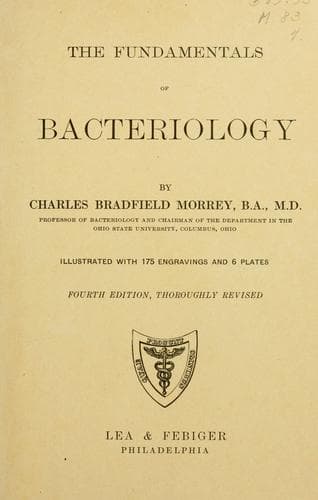
The Fundamentals of BacteriologyMorrey, Charles Bradfield
Science
The Fundamentals of Bacteriology
Morrey, Charles Bradfield
Bacteriology
The method of preparing antitoxins is essentially the same in all
cases, though differing in minor details. For commercial purposes
large animals are selected, usually horses, so that the yield of
serum may be large. The animals must, of course, be vigorous, free
from all infectious disease. The first injection given is either a
relatively small amount of a solution of toxin or of a mixture of
toxin and antitoxin. The animal shows more or less reaction, increased
temperature, pulse and respiration and frequently an edema at the
point of injection, unless this is made intravenously. After several
days to a week or more, when the animal has recovered from the first
injection, a second stronger dose is given, usually with less reaction.
Increasingly large doses are given at proper intervals until the animal
may take several hundred times the amount which would have been fatal
if given at first. The process of immunizing a horse for diphtheria or
tetanus toxin usually takes several months. Variations in time and in
yield of antitoxin are individual and not predictable in any given case.
After several injections a few hundred cubic centimeters of blood
are withdrawn from the jugular vein and serum from this is tested
for the amount of antitoxin it contains. When the amount is found
sufficiently large (250 “units” at least for diphtheria per cc.)[24]
then the maximum amount of blood is collected from the jugular with
sterile trocar and cannula. The serum from this blood with the addition
of an antiseptic (0.5 per cent. phenol, tricresol, etc.) constitutes
“antidiphtheritic serum” or “antitetanic serum,” etc. All sera which
are put on the market must conform to definite standards of strength
expressed in “units” as determined by the U. S. Hygienic Laboratory.
In reality a “unit” of diphtheria antitoxin in the United States is
an amount equivalent to 1 cc. of a given solution of a _standard_
diphtheria _antitoxin_ which is kept at the above-mentioned laboratory.
This statement, of course, gives no definite idea as to the amount
of antitoxin actually in a “unit.” Specifically stated, a “unit” of
antitoxin contains approximately the amount which would protect a 250
gram guinea-pig from 100 minimum lethal doses of diphtheria toxin, or
protect 100 guinea-pigs weighing 250 grams each from one minimum lethal
dose each. The minimum lethal dose (M. L. D.) of diphtheria toxin is
the least amount that will kill a guinea-pig of the size mentioned
within four days. Since toxins on standing change into toxoids to a
great extent, the amount, of antitoxin in a “unit,” though protecting
against 100 M. L. D., in reality would protect against about 200 M. L.
D. of toxin containing no toxoid.
Public-domain text, read in full here on John Shaqi.
Reviews
Reviews
No reviews yet
Be the first to share your thoughts on this work.
Elsewhere in the archive
Join the Discussion
Join the discussion
Sign in to leave a comment or review.
Sign InorCreate an account