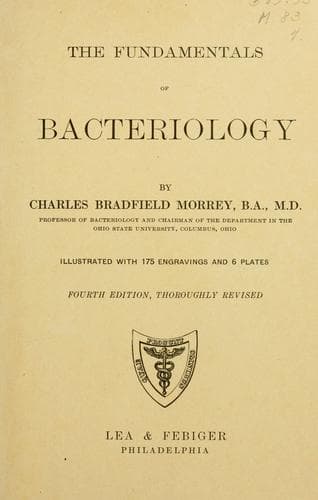
The Fundamentals of BacteriologyMorrey, Charles Bradfield
Science
The Fundamentals of Bacteriology
Morrey, Charles Bradfield
Bacteriology
Just as an unidentified _disease_ in an animal may be determined by
testing its serum as above described against _known_ kinds of bacteria,
so _unknown bacteria_ isolated from an animal, from water, etc., may
be identified by testing them against the _blood sera_ of different
animals, each of which has been properly inoculated with a different
kind of _known bacteria_. If the unknown organism is agglutinated
by the blood of one of the animals in high dilution, and not by the
others, evidently the bacterium is the same as that with which the
animal has been inoculated, or _immunized_, as is usually stated. This
method of identifying cultures of bacteria is of wide application,
but is used practically only in those cases where other methods of
identification are not readily applied, and especially where other
methods are _not sufficient_ as in the “intestinal group” of organisms
in human practice.
The diagnosis of disease in an animal by testing its serum is also a
valuable and much used procedure. This is the method of the “Widal” or
“Gruber-Widal” test for typhoid fever in man and is used in veterinary
practice in testing for glanders, contagious abortion, etc. In some
cases a dilution of the serum of from 20 to 50 times is sufficient for
diagnosis (Malta fever), in most cases, however, 50 times is the lowest
limit. Evidently the greater the dilution, that is, the higher the
“titer,” the more specific is the reaction.
PRECIPITINS.
Since agglutinins act on bacteria, probably through the presence of
substances within the bacterial cell, it is reasonable to expect that
if these substances be dissolved out of the cell, there would be some
reaction between their (colloidal) solution and the same serum. As
a matter of fact Kraus (1897) showed that broth cultures freed from
bacteria by porcelain filters do show a precipitate when mixed with
the serum of an animal immunized against the particular bacterium and
that the reaction is specific under proper conditions of dilution.
It was not long after Kraus’s work until the experiments were tried
of “immunizing” an animal not against a bacterium or its filtered
culture, but against (colloidal) solutions of proteins, such as white
of egg, casein of milk, proteins of meat and of blood serum, vegetable
proteins, etc. It was ascertained that in all these cases the animal’s
serum contains a substance which causes a _precipitate_ with solutions
of the protein used for immunization. The number of such precipitating
serums that have been made experimentally is very large and it appears
that protein from any source when properly introduced into the blood
or tissues of an animal will cause the formation of a precipitating
substance for its solutions. This substance is known, technically as a
“_precipitin_.” The protein used as antigen to stimulate its formation,
or some part of the protein molecule (haptophore group), which acts
as stimulus to the cell is spoken of as a “precipitinogen,” both
Public-domain text, read in full here on John Shaqi.
Reviews
Reviews
No reviews yet
Be the first to share your thoughts on this work.
Elsewhere in the archive
Join the Discussion
Join the discussion
Sign in to leave a comment or review.
Sign InorCreate an account