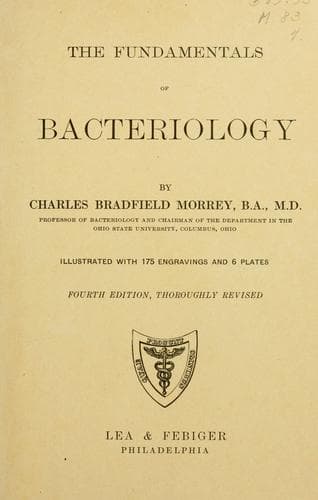
The Fundamentals of BacteriologyMorrey, Charles Bradfield
Science
The Fundamentals of Bacteriology
Morrey, Charles Bradfield
Bacteriology
The complement-fixation test might be applied to the determination
of unknown bacteria, using the unknown culture as antigen and trying
it with the sera of different animals immunized against a variety
of organisms, some one of which might prove to furnish _specific
amboceptor_ for the unknown organism and hence indicate what it is. The
test used in this way has not been shown to be a practical necessity
and hence is rarely employed. It has been used, however, to detect
traces of unknown proteins, particularly blood-serum proteins, in
medico-legal cases in exactly the above outlined manner and is very
delicate and accurate.
CHAPTER XXX.
PHAGOCYTOSIS--OPSONINS.
It has been mentioned that Metchnikoff, in a publication in 1883,
attempted to explain immunity on a purely cellular basis. It has
been known since Haeckel’s first observation in 1858 that certain of
the white corpuscles do engulf solid particles that may get into the
body, and among them bacteria. Metchnikoff at first thought that this
engulfing and subsequent intracellular digestion of the microörganisms
were sufficient to protect the body from infection. The later
discoveries (discussed in considering Ehrlich’s theory of immunity)
of substances present in the blood serum and even in the blood plasma
which either destroy the bacteria or neutralize their action have
caused Metchnikoff to modify his theory to a great extent. He admitted
the presence of these substances, though giving them other names,
but ascribed their formation to the phagocytes or to the same organs
which form the leukocytes--lymphoid tissue generally, bone marrow. It
is not within the province of this work to attempt to reconcile these
theories, but it may be well to point out that Ehrlich’s theory is one
of _chemical substances_ and that the _origin_ of these substances is
not an _essential_ part of the theory, so that the two theories, except
in some minor details, are not necessarily mutually exclusive.
[Illustration: PLATE V
ELIE METCHNIKOFF]
Sir A. E. Wright and Douglas, in 1903, showed that even in those
instances where immunity depends on phagocytosis, as it certainly does
in many cases, the phagocytes are more or less inactive unless they are
aided by chemical substances present in the blood. These substances
_act on the bacteria, not on the leukocytes_, and change them in such
a way that they are more readily taken up by the phagocytes. Wright
proposed for these bodies the name _opsonin_, derived from a Greek
word signifying “to prepare a meal for.” Neufeld and Rimpau at about
the same time (1904), in studying immune sera, observed substances of
similar action in these sera and proposed the name _bacteriotropins_,
or bacteriotropic substances. There is scarcely a doubt that the two
names are applied to identical substances and that Wright’s name
_opsonin_ should have preference.
Public-domain text, read in full here on John Shaqi.
Reviews
Reviews
No reviews yet
Be the first to share your thoughts on this work.
Elsewhere in the archive
Join the Discussion
Join the discussion
Sign in to leave a comment or review.
Sign InorCreate an account