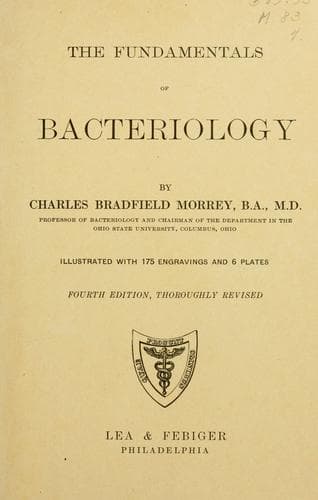
The Fundamentals of BacteriologyMorrey, Charles Bradfield
Science
The Fundamentals of Bacteriology
Morrey, Charles Bradfield
Bacteriology
Most workers outside the Wright school have failed to recognize any
essential value of determinations of the opsonic index in the use
of vaccines. Some of the reasons for this are as follows: The limit
of error in phagocytic counts may be as great as 50 per cent. in
different series of fifty, hence several hundred must be counted, which
adds greatly to the tediousness and time involved; the variation in
apparently healthy individuals is frequently great, hence the “normal”
is too uncertain; finally the opsonic index and the clinical course of
the disease do not by any means run parallel. Undoubtedly the method
has decided value in the hands of an individual who makes opsonic
determinations his chief work, as Wright’s assistants do, but it can
scarcely be maintained at the present time that such determinations
are necessary in vaccine therapy. Nevertheless that opsonins actually
exist and that they play an essential part in phagocytosis, and hence
in immunity, is now generally recognized.
BACTERIAL VACCINES.
Whether determinations of opsonic index are useful or not is largely
a matter of individual opinion, but there is scarcely room to doubt
that Wright has conferred a lasting benefit by his revival of the
use of _dead cultures of bacteria_, _bacterial vaccines_, both for
protective inoculation and for treatment. It is perhaps better to use
the older terms “vaccination” and “vaccine” (though the cow, _vacca_,
is not concerned) than to use Wright’s term “opsonic method” in this
connection, bearing in mind that the idea of a vaccine is that it
contains the _causative organism_ of the infection as indicated on p.
253.
As early as 1880 Touissant proposed the use of dead cultures of
bacteria to produce immunity. But because injections of such cultures
were so frequently followed by abscess formation, doubtless due to
the _high temperatures_ used to kill the bacteria, the method was
abandoned. Further, Pasteur and the French school persistently denied
the possibility of success with such a procedure, and some of them
even maintain this attitude at the present time. The successes of
Wright and the English school which are being repeated so generally
wherever properly attempted, leave no doubt in the unprejudiced of the
very great value of the method and have unquestionably opened a most
promising field both for preventive inoculation and for treatment in
many infectious diseases. That the practice is no more universally
applicable than are immune serums and that it has been and is still
being grossly overexploited is undoubted.
Public-domain text, read in full here on John Shaqi.
Reviews
Reviews
No reviews yet
Be the first to share your thoughts on this work.
Elsewhere in the archive
Join the Discussion
Join the discussion
Sign in to leave a comment or review.
Sign InorCreate an account