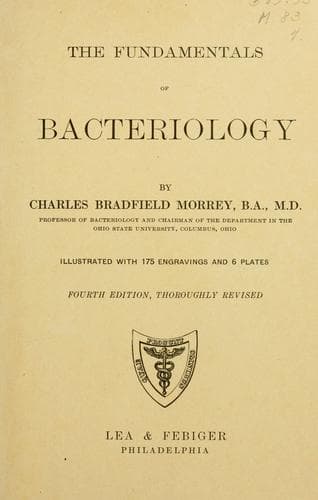
The Fundamentals of BacteriologyMorrey, Charles Bradfield
Science
The Fundamentals of Bacteriology
Morrey, Charles Bradfield
Bacteriology
In the practical application of any remedy the _dosage_ is most
important. Unfortunately there is no accurate method of determining
this with a vaccine. Wright recommended determining the number of
the organisms per cc. as before mentioned, and his method or some
modification of it is still in general use. From what was said with
regard to variation, both in organisms and in individuals, it can
be seen that the number of organisms is at least only a very rough
guide. This is further illustrated by the doses of micrococcus
(staphylococcus) vaccines recommended by different writers, which
vary from 50,000,000 to 2,000,000,000 per cc. The author is decidedly
of the opinion that _there is no way of determining the dosage of
a vaccine in the treatment of any given case except by the result
of the first dose_. Hence it is his practice to make vaccines of a
particular organism of the same approximate strength, and to give a
dose of a measured portion of a cubic centimeter, judging the amount
by what the individual or animal can apparently withstand, without too
violent a reaction. If there is no local or general reaction or if it
is very slight and there is no effect on the lesion, the dose is too
small. If there is a violent local reaction with severe constitutional
symptoms clinically, and the lesion appears worse, the dose is too
large. There should be some local reaction and some general, but not
enough to cause more than a slight disturbance, easy to judge in human
subjects, more difficult in animals. In cases suitable for vaccine
treatment no _serious_ results should follow from a properly prepared
vaccine, though the process of healing may be delayed temporarily.
Wright claimed, and many have substantiated him, that always following
a vaccination there is a period when the resistance of the animal is
diminished. This is called the “negative phase,” and Wright considered
this to last as long as the opsonic index remained low, and when this
latter began to increase the stage of the “positive” or favorable phase
was reached. As has been stated the opsonic index is pretty generally
regarded as of doubtful value, though the existence of a period of
lowered resistance is theoretically probable from the fact that
antibodies already present in the blood will be partially used up in
uniting with the vaccine introduced and that the body cells are called
upon suddenly to do an extra amount of work and it takes them some time
to adapt themselves. This time, the “negative phase,” is much better
determined by the clinical symptoms, general and especially local. It
is good practice to begin with a dose relatively small. The result
of this is an indication of the proper dosage and also prepares the
patient for a larger one. The second dose should follow the first not
sooner than three or four days, and should be five to seven days if the
first reaction is severe. These directions are not very definite, but
clinical experience to date justifies them.
Public-domain text, read in full here on John Shaqi.
Reviews
Reviews
No reviews yet
Be the first to share your thoughts on this work.
Elsewhere in the archive
Join the Discussion
Join the discussion
Sign in to leave a comment or review.
Sign InorCreate an account