The Fundamentals of BacteriologyMorrey, Charles Bradfield
Science
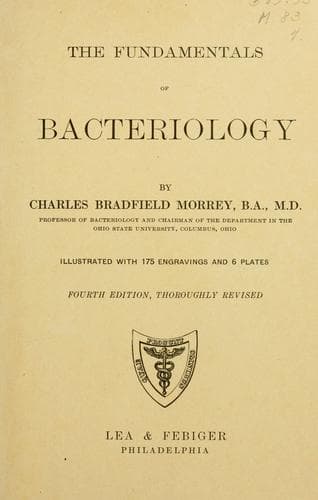
The Fundamentals of Bacteriology
Morrey, Charles Bradfield
Bacteriology
It must be remembered that proteins do not normally get into the
circulation except by way of the alimentary tract. Here all proteins
that are absorbed are first broken down to their constituent
amino-acids, absorbed as such and these are built up into the proteins
characteristic of the animal’s blood. Hence when protein as such gets
into the blood it is a foreign substance to be disposed of. The blood
contains proteolytic enzymes for certain proteins normally. It is
also true that the body cells possess the property of digesting the
proteins of the blood and building them up again into those which are
characteristic of the cell. Hence it appears rational to assume that
the foreign proteins act as stimuli to certain cells to produce more
of the enzymes necessary to decompose them, so that they may be either
built up into cell structure or eliminated as waste. If in this process
of splitting up of protein a poison were produced, then the phenomena
of “anaphylaxis” could be better understood. As a matter of fact
Vaughan and his co-workers have shown that by artificially splitting
up proteins from many different sources--animal, vegetable, pathogenic
and saprophytic bacteria--a poison _is produced_ which appears to be
the same in all cases and which causes the symptoms characteristic of
anaphylaxis. On the basis of these facts it is seen that anaphylaxis
is simply another variety of immunity. The _specific antibody_ in
this case is an _enzyme_ which decomposes the protein instead of
precipitating it. The enzyme must be specific for the protein since
these differ in constitution. Vaughan even goes so far as to say that
the poison is really the central ring common to all proteins and that
they differ only in the lateral groups or side chains attached to this
central nucleus. The action of the enzyme in this connection would be
to split off the side chains, and since these are the specific parts of
the protein, the enzyme must be specific for each protein. The pepsin
of the gastric juice and the trypsin of the pancreas split the native
proteins only to peptones. As is well known, these when injected in
sufficient quantity give rise to poisonous symptoms, and will also
give rise to anaphylaxis under properly spaced injections. They do not
poison normally because they are split by the intestinal erepsin to
amino-acids and absorbed as such. Whether Vaughan’s theory of protein
structure is the true one or not remains to be demonstrated. It is
not essential to the theory of anaphylaxis above outlined, _i.e._,
a phenomenon due to the action of specific _antibodies_ which are
enzymes. On physiological grounds this appears the most rational of the
few explanations of anaphylaxis that have been offered and was taught
by the author before he had read Vaughan’s theory along the same lines.
Public-domain text, read in full here on John Shaqi.
Reviews
Reviews
No reviews yet
Be the first to share your thoughts on this work.
Elsewhere in the archive
Join the Discussion
Join the discussion
Sign in to leave a comment or review.
Sign InorCreate an account