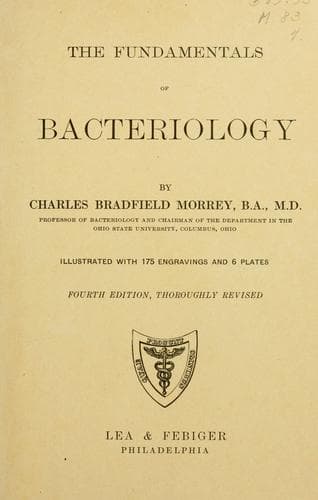
The Fundamentals of BacteriologyMorrey, Charles Bradfield
Science
The Fundamentals of Bacteriology
Morrey, Charles Bradfield
Bacteriology
[8] The sulphur bacteria are partially prototrophic for S; probably the
iron bacteria also for Fe. Some few soil bacteria have been shown to
be capable of utilizing free H, and it seems certain that the bacteria
associated with the spontaneous heating of coal may oxidize free C. So
far as known no elements other than these six are directly available to
bacteria.
[9] Only a few kinds of bacteria so far as known are proto-autotrophic.
The nitrous and nitric organisms of Winogradsky which are so essential
in the soil, and which might have been the first of all organisms so
far as their food is concerned, and some of the sulphur bacteria are
examples.
[10] The term _pathogenic_ is also applied to certain non-parasitic
saprophytic bacteria whose products cause disease conditions, as one
of the organisms causing a type of food poisoning in man (_Clostridium
botulinum_), which also probably causes “forage poisoning” in domestic
animals.
[11] The term “fermentation” was originally used to denote the process
which goes on in fruit juices or grain extracts when alcohol and gas
are formed. Later it was extended to apply to the decomposition of
almost any organic substance. In recent years the attempt has been made
to give a chemical definition to the word by restricting its use to
those changes in which by virtue of a “wandering” or rearrangement of
the carbon atoms “new substances are formed which are not constitutents
of the original molecule.” It may be doubted whether this restriction
is justified or necessary. A definition is at present scarcely possible
except when the qualifying adjective is included as “alcoholic
fermentation,” “ammoniacal fermentation,” “lactic acid fermentation,”
etc.
[12] See “Oil and Gas in Ohio,” Bownocker: Geological Survey of Ohio,
Fourth Series, Bull. I, pp. 313-314.
[13] It is probable that this is the way “Jack o’lanterns” or “Will o’
the wisps” are ignited. Marsh gas is produced as above outlined from
the vegetable and animal matter decomposing in swampy places under
anaërobic conditions and likewise phosphine. These escape into the air
and the “spontaneous combustion” of the phosphine ignites the marsh gas.
[14] Dr. H. H. Green, of Pretoria, South Africa, has isolated from
“cattle dips” a bacterium that _reduces arsenates_ to _arsenites_.
[15] Dr. Green (l. c.) has also isolated an organism which causes some
deterioration of cattle dips by _oxidizing arsenites to arsenates_.
[16] It will be noted that the names of enzymes (except some of
those first discovered) terminate in _ase_ which is usually added to
the _stem of the name of the substance acted on_, though sometimes
to a word which indicates the substance formed by the action, as
_lactacidase_, _alcoholase_.
[17] Tetanus toxin is about 120 times as poisonous as strychnin, both
of which act on the same kind of nerve cells.
Public-domain text, read in full here on John Shaqi.
Reviews
Reviews
No reviews yet
Be the first to share your thoughts on this work.
Elsewhere in the archive
Join the Discussion
Join the discussion
Sign in to leave a comment or review.
Sign InorCreate an account