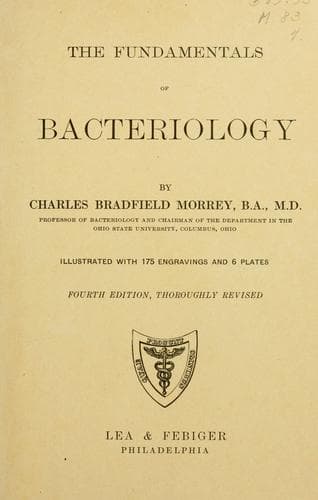
The Fundamentals of BacteriologyMorrey, Charles Bradfield
Science
The Fundamentals of Bacteriology
Morrey, Charles Bradfield
Bacteriology
Ordinarily, more attention must be paid to the sources of the two
elements N and C than to the others, for in general the substances
used to furnish these two and the water contain the other elements in
sufficient amount. For very exact work on the products of bacteria,
_synthetic media_ containing definite amounts of chemicals of known
composition have been prepared, but for most of the work with bacteria
pathogenic to animals such media are not needed.
Culture media may be either _liquid_ or _solid_, or for certain
purposes may be liquid at higher temperatures and solid at lower, as
indicated later. Liquid media are of value for obtaining bacteria for
the study of morphology and cell groupings and for ascertaining many of
the physiological activities of the organisms. Solid media are useful
for studying some few of the physiological activities and especially
for determining characteristic appearances of the isolated growths
of bacteria. These isolated growths of bacteria on solid media are
technically spoken of as “_colonies_,” whether they are microscopic in
size or visible to the unaided eye.
It is clear that the kinds of culture media used for the study of
bacteria may be unlimited but the undergraduate student will need to
use a relatively small number, which will be discussed in this section.
=Meat Broth (Bouillon).=[20]--This itself is used as a medium and as
the basis for the preparation of other solid and liquid media.
Finely ground _lean_ beef is selected because it contains the necessary
food materials. Fat is not desired since it is a poor food for most
bacteria and in the further processes of preparation would be melted
and form an undesirable film on the surface of the medium. The meat is
placed in a suitable container and mixed with about twice its weight of
_cold_ water (not distilled) and allowed to soak overnight or longer.
The cold water extracts from the meat water-soluble proteins, blood,
carbohydrates in the form of dextrose (occasionally some glycogen),
nitrogenous extractives and some of the mineral salts. The fluid is
strained or pressed free from the meat. This “meat juice” should now
be thoroughly boiled, which results in a coagulation of a large part
of the proteins and a precipitation of some of the mineral salts,
particularly phosphates of calcium and magnesium, both of which must be
filtered off and the water loss restored by adding the proper amount of
distilled water. The boiling is done at this point because the medium
must later be heated to sterilize it and it is best to get rid of the
coagulable proteins at once. The proteins thus thrown out deprive
the medium of valuable nitrogenous food material which is replaced
by adding about 1 per cent. by weight of commercial peptone. It is
usual also (though not always necessary) to add about 0.5 per cent. by
weight of common salt which helps to restore the proper concentration
of mineral ingredients lost by the boiling. The chlorine is also an
Public-domain text, read in full here on John Shaqi.
Reviews
Reviews
No reviews yet
Be the first to share your thoughts on this work.
Elsewhere in the archive
Join the Discussion
Join the discussion
Sign in to leave a comment or review.
Sign InorCreate an account