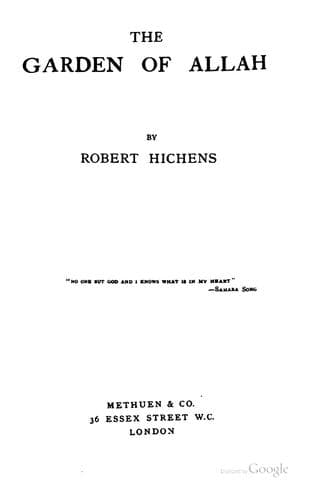
Africa, North -- Fiction; British -- Africa, North -- Fiction; Love stories; Married women -- Fiction
She joined him, concealing her reluctance to leave Androvsky with the
priest, and walked beside him down the path, preceded by Bous-Bous.
“Is my _fete_ going to be a failure?” he murmured.
She did not reply. Her heart was full of vexation, almost of bitterness.
She felt angry with Count Anteoni, with Androvsky, with herself. She
almost felt angry with poor Father Roubier.
“Forgive me! do forgive me!” the Count whispered. “I meant no harm.”
She forced herself to smile, but the silence behind them, where the two
men were following, oppressed her. If only Androvsky would speak! He had
not said one word since they were all together. Suddenly she turned her
head and said:
“Did you ever see such palms, Monsieur Androvsky? Aren’t they
magnificent?”
Her voice was challenging, imperative. It commanded him to rouse
himself, to speak, as a touch of the lash commands a horse to quicken
his pace. Androvsky raised his head, which had been sunk on his breast
as he walked.
“Palms!” he said confusedly.
“Yes, they are wonderful.”
“You care for trees?” asked the Count, following Domini’s lead and
speaking with a definite intention to force a conversation.
“Yes, Monsieur, certainly.”
“I have some wonderful fellows here. After _dejeuner_ you must let me
show them to you. I spent years in collecting my children and teaching
them to live rightly in the desert.”
Very naturally, while he spoke, he had joined Androvsky, and now walked
on with him, pointing out the different varieties of trees. Domini was
conscious of a sense of relief and of a strong feeling of gratitude
to their host. Following upon the gratitude came a less pleasant
consciousness of Androvsky’s lack of good breeding. He was certainly not
a man of the world, whatever he might be. To-day, perhaps absurdly, she
felt responsible for him, and as if he owed it to her to bear himself
bravely and govern his dislikes if they clashed with the feelings of
his companions. She longed hotly for him to make a good impression, and,
when her eyes met Father Roubier’s, was almost moved to ask his pardon
for Androvsky’s rudeness. But the Father seemed unconscious of it, and
began to speak about the splendour of the African vegetation.
“Does not its luxuriance surprise you after England?” he said.
“No,” she replied bluntly. “Ever since I have been in Africa I have felt
that I was in a land of passionate growth.”
“But--the desert?” he replied with a gesture towards the long flats of
the Sahara, which were still visible between the trees.
“I should find it there too,” she answered. “There, perhaps, most of
all.”
He looked at her with a gentle wonder. She did not explain that she was
no longer thinking of growth in Nature.
Public-domain text, read in full here on John Shaqi.
Reviews
Reviews
No reviews yet
Be the first to share your thoughts on this work.
Elsewhere in the archive
Join the Discussion
Join the discussion
Sign in to leave a comment or review.
Sign InorCreate an account