Africa, North -- Fiction; British -- Africa, North -- Fiction; Love stories; Married women -- Fiction
Both Father Roubier and Androvsky looked at her with expectancy. But she
did not continue her sentence, and her failure to do so was covered, or
at the least excused, by a diversion that secretly she blessed. At this
moment, from the ante-room, there came a sound of African music, both
soft and barbarous. First there was only one reiterated liquid note,
clear and glassy, a note that suggested night in a remote place. Then,
beneath it, as foundation to it, rose a rustling sound as of a forest
of reeds through which a breeze went rhythmically. Into this stole the
broken song of a thin instrument with a timbre rustic and antique as
the timbre of the oboe, but fainter, frailer. A twang of softly-plucked
strings supported its wild and pathetic utterance, and presently the
almost stifled throb of a little tomtom that must have been placed at a
distance. It was like a beating heart.
The Count and his guests sat listening in silence. Domini began to
feel curiously expectant, yet she did not recognise the odd melody. Her
sensation was that some other music must be coming which she had heard
before, which had moved her deeply at some time in her life. She glanced
at the Count and found him looking at her with a whimsical expression,
as if he were a kind conspirator whose plot would soon be known.
“What is it?” she asked in a low voice.
He bent towards her.
“Wait!” he whispered. “Listen!”
She saw Androvsky frown. His face was distorted by an expression of
pain, and she wondered if he, like some Europeans, found the barbarity
of the desert music ugly and even distressing to the nerves. While
she wondered a voice began to sing, always accompanied by the four
instruments. It was a contralto voice, but sounded like a youth’s.
“What is that song?” she asked under her breath. “Surely I must have
heard it!”
“You don’t know?”
“Wait!”
She searched her heart. It seemed to her that she knew the song. At some
period of her life she had certainly been deeply moved by it--but when?
where? The voice died away, and was succeeded by a soft chorus singing
monotonously:
“Wurra-Wurra.”
Then it rose once more in a dreamy and reticent refrain, like the voice
of a soul communing with itself in the desert, above the instruments and
the murmuring chorus.
“You remember?” whispered the Count.
She moved her head in assent but did not speak. She could not speak. It
was the song the Arab had sung as he turned into the shadow of the palm
trees, the song of the freed negroes of Touggourt:
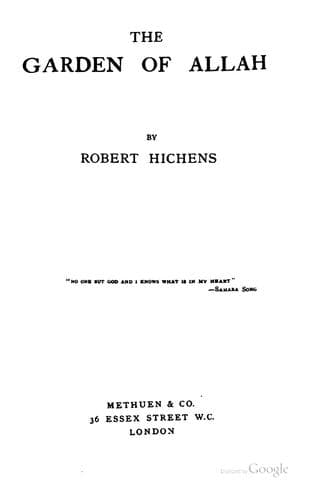
“No one but God and I
Knows what is in my heart.”
The priest leaned back in his chair. His dark eyes were cast down, and
his thin, sun-browned hands were folded together in a way that suggested
prayer. Did this desert song of the black men, children of God like
him as their song affirmed, stir his soul to some grave petition that
embraced the wants of all humanity?
Public-domain text, read in full here on John Shaqi.
Reviews
Reviews
No reviews yet
Be the first to share your thoughts on this work.
Elsewhere in the archive
Join the Discussion
Join the discussion
Sign in to leave a comment or review.
Sign InorCreate an account