Africa, North -- Fiction; British -- Africa, North -- Fiction; Love stories; Married women -- Fiction
She stopped. In the distance, by the great fire where the Arabs were
assembled, there rose a sound of music which arrested her attention. Ali
was singing, holding in his hand a brand from the fire like a torch. She
had heard him sing before, and had loved the timbre of his voice, but
only now did she realise when she had first heard him and who he was. It
was he who, hidden from her, had sung the song of the freed negroes of
Touggourt in the gardens of Count Anteoni that day when she had been
angry with Androvsky and had afterwards been reconciled with him. And
she knew now it was he, because, once more hidden from her--for against
the curtain of darkness she only saw the flame from the torch he held
and moved rhythmically to the burden of his song--he was singing it
again. Androvsky, when she ceased to speak, suddenly put his arms round
her, as if he were afraid of her escaping from him in her silence, and
they stood thus at the tent door listening:
“The gazelle dies in the water,
The fish dies in the air,
And I die in the dunes of the desert sand
For my love that is deep and sad.”
The chorus of hidden men by the fire rose in a low murmur that was like
the whisper of the desert in the night. Then the contralto voice of Ali
came to Domini and Androvsky again, but very faintly, from the distance
where the flaming torch was moving:
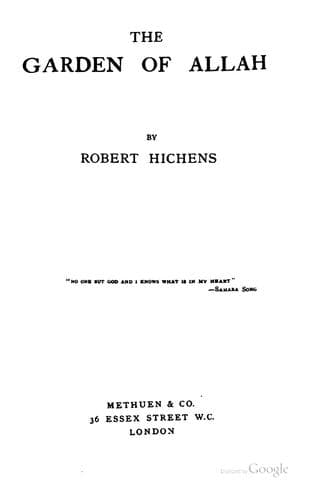
“No one but God and I
Knows what is in my heart.”
When the voice died away for a moment Domini whispered the refrain. Then
she said:
“But is it true? Can it be true for us to-night?”
Androvsky did not reply.
“I don’t think it is true,” she added. “You know--don’t you?”
The voice of Ali rose again, and his torch flickered on the soft wind
of the night. Its movement was slow and eerie. It seemed like his voice
made visible, a voice of flame in the blackness of the world. They
watched it. Presently she said once more:
“You know what is in my heart--don’t you?”
“Do I?” he said. “All?”
“All. My heart is full of one thing--quite full.”
“Then I know.”
“And,” she hesitated, then added, “and yours?”
“Mine too.”
“I know all that is in it then?”
She still spoke questioningly. He did not reply, but held her more
closely, with a grasp that was feverish in its intensity.
“Do you remember,” she went on, “in the garden what you said about that
song?”
“No.”
“You have forgotten?”
“I told you,” he said, “I mean to forget everything.”
“Everything before we came to Beni-Mora?”
“And more. Everything before you put your hands against my forehead,
Domini. Your touch blotted out the past.”
“Even the past at Beni-Mora?”
“Yes, even that. There are many things I did and left undone, many
things I said and never said that--I have forgotten--I have forgotten
for ever.”
There was a sternness in his voice now, a fiery intention.
“I understand,” she said. “I have forgotten them too, but not some
things.”
“Which?”
Public-domain text, read in full here on John Shaqi.
Reviews
Reviews
No reviews yet
Be the first to share your thoughts on this work.
Elsewhere in the archive
Join the Discussion
Join the discussion
Sign in to leave a comment or review.
Sign InorCreate an account