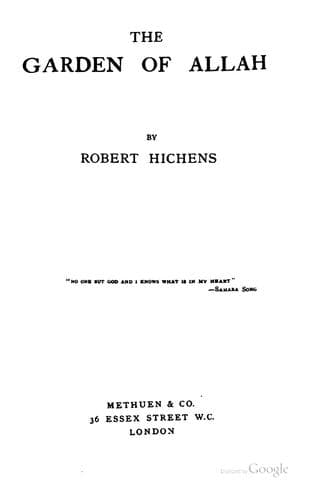
Africa, North -- Fiction; British -- Africa, North -- Fiction; Love stories; Married women -- Fiction
To Domini it sometimes seemed the truest of all the true and beautiful
sayings of the East. Only three weeks had passed away since the first
halt at Arba, yet already her life at Beni-Mora was faint in her mind
as the dream of a distant past. Taken by the vast solitudes, journeying
without definite aim from one oasis to another through empty regions
bathed in eternal sunshine, camping often in the midst of the sand
by one of the wells sunk for the nomads by the French engineers,
strengthened perpetually, yet perpetually soothed, by airs that were
soft and cool, as if mingled of silk and snow, they lived surely in a
desert dream with only a dream behind them. They had become as one with
the nomads, whose home is the moving tent, whose hearthstone is the
yellow sand of the dunes, whose God is liberty.
Domini loved this life with a love which had already become a passion.
All that she had imagined that the desert might be to her she found that
it was. In its so-called monotony she discovered eternal interest. Of
old she had thought the sea the most wonderful thing in Nature. In the
desert she seemed to possess the sea with something added to it, a
calm, a completeness, a mystical tenderness, a passionate serenity. She
thought of the sea as a soul striving to fulfil its noblest aspirations,
to be the splendid thing it knew how to dream of. But she thought of
the desert as a soul that need strive no more, having attained. And she,
like the Arabs, called it always in her heart the Garden of Allah. For
in this wonderful calm, bright as the child’s idea of heaven; clear as
a crystal with a sunbeam caught in it, silent as a prayer that will
be answered silently, God seemed to draw very near to His wandering
children. In the desert was the still, small voice, and the still, small
voice was the Lord.
Often at dawn or sundown, when, perhaps in the distance of the sands,
or near at hand beneath the shade of the palms of some oasis by a
waterspring, she watched the desert men in their patched rags, with
their lean, bronzed faces and eagle eyes turned towards Mecca, bowing
their heads in prayer to the soil that the sun made hot, she remembered
Count Anteoni’s words, “I like to see men praying in the desert,” and
she understood with all her heart and soul why. For the life of the
desert was the most perfect liberty that could be found on earth, and to
see men thus worshipping in liberty set before her a vision of free will
upon the heights. When she thought of the world she had known and left,
of the men who would always live in it and know no other world, she was
saddened for a moment. Could she ever find elsewhere such joy as she had
found in the simple and unfettered life of the wastes? Could she ever
exchange this life for another life, even with Androvsky?
Public-domain text, read in full here on John Shaqi.
Reviews
Reviews
No reviews yet
Be the first to share your thoughts on this work.
Elsewhere in the archive
Join the Discussion
Join the discussion
Sign in to leave a comment or review.
Sign InorCreate an account