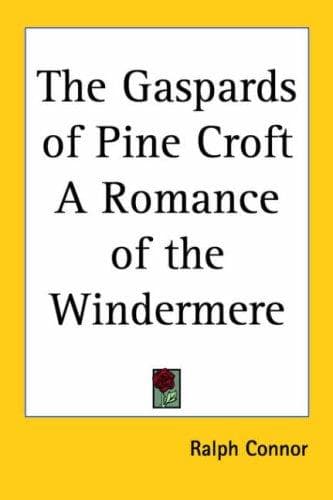
The Gaspards of Pine Croft: A Romance of the WindermereConnor, Ralph
General
The Gaspards of Pine Croft: A Romance of the Windermere
Connor, Ralph
British Columbia -- Fiction; Canadian fiction -- 20th century
One part of his task at least was done. There was no need to break
gently to the boy the news of his father’s homecoming. But the bite in
the announcement still remained. He would have given something to have
seen Paul meet his father and to know the reaction upon the boy of
Gaspard’s _menage_, to employ his wife’s designation. Meantime he rode
slowly home to his wife, sorely distressed for the boy who had become to
him as his own son. The day would doubtless bring its own revelations,
and he was philosopher enough to resolve that he would await
developments. Later events justified the wisdom of this resolve.
The dinner hour brought Gaspard to the big white house in the proud
convoy of his son, to be at first shyly, then warmly welcomed by Peg, an
ardent admirer in the old days. During the dinner there was something
pathetic in the eager, wistful anxiety of the father to appear quite at
his ease and to carry off the situation with his old time aplomb, and
equally pathetic in the boy’s apologetic pride in his father, whose
whole manner somehow did not ring true.
Gaspard was obviously excited and overstrained, eager to please, too
eager indeed, and yet insolently defiant, ready to fight. He seemed to
be continuously conscious of an air of disapproval, if not contempt, on
the part of his hostess. For, do her best, Augusta could not get out of
her mind’s eye the little cavalcade which had accompanied Gaspard to the
bungalow. Hence her disapproving contempt. Why did he bring them back
with him? This was the question which, with irritating insistence, kept
inserting itself among Gaspard’s efforts at brilliant conversation. Not
the existence of that doubtful appanage of his, but his stupid
effrontery in daring to flaunt the whole thing in the face of his
friends and forcing them all to cut him. Augusta had no patience with
such stupidity; indeed, she could not conceive how a man of the world
could be guilty of any such ridiculous proceeding. It was a crime, not
so much against the ethical standards of the valley, but against good
form and common sense. In spite of herself, however, she began to be
conscious of Gaspard’s old time charm. A brilliant conversationalist
when he cared, a man of quite unusual intellectual culture, an art
critic with a sure touch and true feeling, as the dinner advanced and as
the Colonel’s generous old port began to warm the courage of his guest,
Gaspard’s apologetic and wistful air began to evaporate and to give
place to one of confident and complaisant ease. He was talking of “art,”
with a very large capital A, to which he had been led by an appreciative
reference to two new Raeburns which had recently arrived from England.
He knew the artist’s work and his school. Once launched, he was off on a
very even keel and with a steady breeze, over somewhat troubled waters,
stretching from the pre-Raphaelites to the Cubists. From that to student
days in the _Quartier Latin_, thence to his struggles with the hanging
Public-domain text, read in full here on John Shaqi.
Reviews
Reviews
No reviews yet
Be the first to share your thoughts on this work.
Elsewhere in the archive
Join the Discussion
Join the discussion
Sign in to leave a comment or review.
Sign InorCreate an account