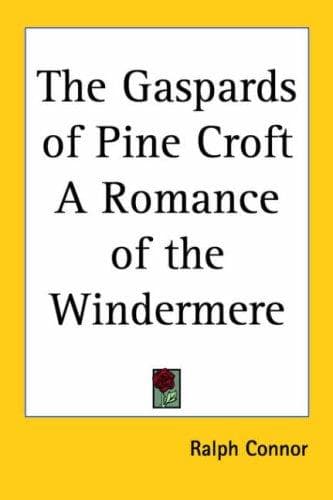
The Gaspards of Pine Croft: A Romance of the WindermereConnor, Ralph
General
The Gaspards of Pine Croft: A Romance of the Windermere
Connor, Ralph
British Columbia -- Fiction; Canadian fiction -- 20th century
His father was eager to supplement in the education of his son the
elements which might be lacking in the instruction received at the big
white house, which, however excellent of its kind, partook somewhat of
the quality and characteristics of that received in an English Dame
School. With this idea in mind, the boy was initiated into the mysteries
of the elements of engineering, and under his father’s instruction began
to apply in a series of primitive experiments the principles of the
science to road building, bridge construction, water wheels, the laying
of water mains, and such like practical undertakings. Many a long and
delightful afternoon the boy toiled at construction work, with his
father watching while he lay and smoked, occasionally throwing a word of
advice or lending a hand.
In these studies and occupations, Peter was his constant companion and
worshipful assistant.
Between the Indian woman and Paul hung a veil of reserve which neither
seemed able to remove. The woman herself seemed unwilling to take the
place of wife and mother in the household. Centuries of tradition
wrought in her soul an ineradicable sense of subordination to her lord
and master. At the family table Gaspard insisted that she take her
place, but inasmuch as the charge of the household duties fell upon her
alone she seized every opportunity to serve her lord as the women of her
race had served from time immemorial, rather than preside as his equal
in the family. This was especially the case at such times as Paul
happened to be a member of the family circle, and had it not been for
Gaspard’s express command she on every occasion would have played the
part of servant to her master and the “young chief,” as she sometimes
shyly named him. Her love for the boy, which was with her second only to
that for her lord and master, was a strange mingling of maternal
tenderness and of adoration for something high and remote.
As for Paul, he could not have analysed to himself, much less explained
to any other, just in what light he considered the Indian woman who
occupied such a peculiar place in the household. What that place was
Paul, having never been told, was too reserved to enquire. His father
had never spoken of it, taking for granted that the boy had understood,
and no other had ventured to speak of the matter. For his twelve years
the boy had developed an unusual ability to do his own thinking on many
subjects, and, moreover, he carried an air of reserve that forbade
intrusion into the more intimate things of life.
For one member of the household, however, the sixteen-months babe, Paul
developed a swift and absorbing devotion. At his first sight of her the
boy utterly lost his heart, and thenceforward was her slave. For half a
century of a life teeming with incident and rich in emotion he was never
to forget that first vision of little Tannawita—“Singing Water.”
Public-domain text, read in full here on John Shaqi.
Reviews
Reviews
No reviews yet
Be the first to share your thoughts on this work.
Elsewhere in the archive
Join the Discussion
Join the discussion
Sign in to leave a comment or review.
Sign InorCreate an account