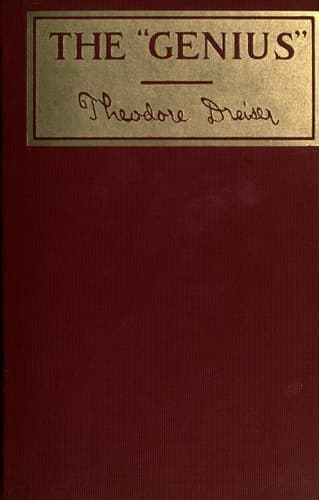
Artists -- Relations with women -- Fiction; Artists -- United States -- Fiction
Having gone so far as to indicate that he would take it--he was made to
feel partially resigned to marriage by the very appearance of this
place--he decided that he would marry in October. Angela could come to
New York or Buffalo--she had never seen Niagara Falls--and they could be
married there. She had spoken recently of visiting her brother at West
Point. Then they could come here and settle down. He decided that this
must be so, wrote to her to that effect, and vaguely hinted to Smite and
MacHugh that he might get married shortly.
This was a great blow to his partners in art, for Eugene was very
popular with them. He had the habit, with those he liked, of jesting
constantly. "Look at the look of noble determination on Smite's brow
this morning," he would comment cheerfully on getting up; or "MacHugh,
you lazy lout, crawl out and earn your living."
MacHugh's nose, eyes and ears would be comfortably buried in the folds
of a blanket.
"These hack artists," Eugene would sigh disconsolately. "There's not
much to be made out of them. A pile of straw and a couple of boiled
potatoes a day is all they need."
"Aw, cut it out," MacHugh would grunt.
"To hell, to hell, I yell, I yell," would come from somewhere in the
voice of Smite.
"If it weren't for me," Eugene would go on, "God knows what would become
of this place. A lot of farmers and fishermen trying to be artists."
"And laundry wagon drivers, don't forget that," MacHugh would add,
sitting up and rubbing his tousled head, for Eugene had related some of
his experiences. "Don't forget the contribution made by the American
Steam Laundry Company to the world of true art."
"Collars and cuffs I would have you know is artistic," Eugene at once
declared with mock dignity, "whereas plows and fish is trash."
Sometimes this "kidding" would continue for a quarter of an hour at a
stretch, when some one remark really brighter than any other would
dissolve the whole in laughter. Work began after breakfast, to which
they usually sallied forth together, and would continue unbroken save
for necessary engagements or periods of entertainment, lunch and so on,
until five in the afternoon.
Public-domain text, read in full here on John Shaqi.
Reviews
Reviews
No reviews yet
Be the first to share your thoughts on this work.
Elsewhere in the archive
Join the Discussion
Join the discussion
Sign in to leave a comment or review.
Sign InorCreate an account