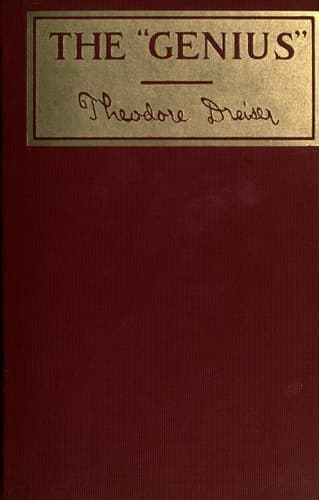
Artists -- Relations with women -- Fiction; Artists -- United States -- Fiction
By such an illusion was Eugene's mind possessed. He had no conception of
what life would bring him for his efforts. He thought if he could have
his pictures hung in a Fifth Avenue gallery much as he had seen
Bouguereau's "Venus" in Chicago, with people coming as he had come on
that occasion--it would be of great comfort and satisfaction to him. If
he could paint something which would be purchased by the Metropolitan
Museum in New York he would then be somewhat of a classic figure,
ranking with Corot and Daubigny and Rousseau of the French or with
Turner and Watts and Millais of the English, the leading artistic
figures of his pantheon. These men seemed to have something which he did
not have, he thought, a greater breadth of technique, a finer
comprehension of color and character, a feeling for the subtleties at
the back of life which somehow showed through what they did. Larger
experience, larger vision, larger feeling--these things seemed to be
imminent in the great pictures exhibited here, and it made him a little
uncertain of himself. Only the criticism in the _Evening Sun_ fortified
him against all thought of failure. _He was an artist._
He gathered up the various oils he had done--there were some twenty-six
all told now, scenes of the rivers, the streets, the night life, and so
forth--and went over them carefully, touching up details which in the
beginning he had merely sketched or indicated, adding to the force of a
spot of color here, modifying a tone or shade there, and finally, after
much brooding over the possible result, set forth to find a gallery
which would give them place and commercial approval.
Eugene's feeling was that they were a little raw and sketchy--that they
might not have sufficient human appeal, seeing that they dealt with
factory architecture at times, scows, tugs, engines, the elevated roads
in raw reds, yellows and blacks; but MacHugh, Dula, Smite, Miss Finch,
Christina, the _Evening Sun_, Norma Whitmore, all had praised them, or
some of them. Was not the world much more interested in the form and
spirit of classic beauty such as that represented by Sir John Millais?
Would it not prefer Rossetti's "Blessed Damozel" to any street scene
ever painted? He could never be sure. In the very hour of his triumph
when the _Sun_ had just praised his picture, there lurked the spectre of
possible intrinsic weakness. Did the world wish this sort of thing?
Would it ever buy of him? Was he of any real value?
"No, artist heart!" one might have answered, "of no more value than any
other worker of existence and no less. The sunlight on the corn, the
color of dawn in the maid's cheek, the moonlight on the water--these are
of value and of no value according to the soul to whom is the appeal.
Fear not. Of dreams and the beauty of dreams is the world compounded."
Public-domain text, read in full here on John Shaqi.
Reviews
Reviews
No reviews yet
Be the first to share your thoughts on this work.
Elsewhere in the archive
Join the Discussion
Join the discussion
Sign in to leave a comment or review.
Sign InorCreate an account