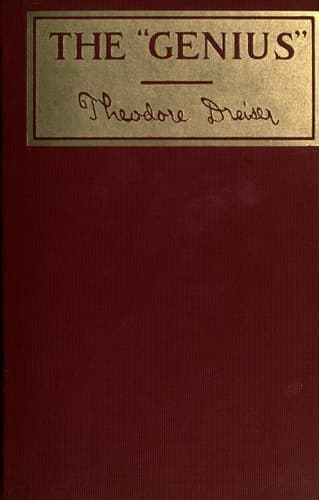
Artists -- Relations with women -- Fiction; Artists -- United States -- Fiction
Days of this kind grow as a rule quickly monotonous. To a man of
Eugene's turn of mind there was so little in Alexandria to entertain
him. After London and Paris, Chicago and New York, the quiet streets of
his old home town were a joke. He visited the office of the _Appeal_ but
both Jonas Lyle and Caleb Williams had gone, the former to St. Louis,
the latter to Bloomington. Old Benjamin Burgess, his sister's husband's
father, was unchanged except in the matter of years. He told Eugene that
he was thinking of running for Congress in the next campaign--the
Republican organization owed it to him. His son Henry, Sylvia's husband,
had become a treasurer of the local bank. He was working as patiently
and quietly as ever, going to church Sundays, going to Chicago
occasionally on business, consulting with farmers and business men about
small loans. He was a close student of the several banking journals of
the country, and seemed to be doing very well financially. Sylvia had
little to say of how he was getting along. Having lived with him for
eleven years, she had become somewhat close-mouthed like himself. Eugene
could not help smiling at the lean, slippered subtlety of the man, young
as he was. He was so quiet, so conservative, so intent on all the little
things which make a conventionally successful life. Like a cabinet
maker, he was busy inlaying the little pieces which would eventually
make the perfect whole.
Angela took up the household work, which Mrs. Witla grudgingly consented
to share with her, with a will. She liked to work and would put the
house in order while Mrs. Witla was washing the dishes after breakfast.
She would make special pies and cakes for Eugene when she could without
giving offense, and she tried to conduct herself so that Mrs. Witla
would like her. She did not think so much of the Witla household. It
wasn't so much better than her own--hardly as good. Still it was
Eugene's birthplace and for that reason important. There was a slight
divergence of view-point though, between his mother and herself, over
the nature of life and how to live it. Mrs. Witla was of an easier, more
friendly outlook on life than Angela. She liked to take things as they
came without much worry, while Angela was of a naturally worrying
disposition. The two had one very human failing in common--they could
not work with anyone else at anything. Each preferred to do all that was
to be done rather than share it at all. Both being so anxious to be
conciliatory for Eugene's sake and for permanent peace in the family,
there was small chance for any disagreement, for neither was without
tact. But there was just a vague hint of something in the air--that
Angela was a little hard and selfish, on Mrs. Witla's part; that
Mrs. Witla was just the least bit secretive, or shy or distant--from
Angela's point of view. All was serene and lovely on the surface,
however, with many won't-you-let-me's and please-do-now's on both sides.
Mrs.
Public-domain text, read in full here on John Shaqi.
Reviews
Reviews
No reviews yet
Be the first to share your thoughts on this work.
Elsewhere in the archive
Join the Discussion
Join the discussion
Sign in to leave a comment or review.
Sign InorCreate an account