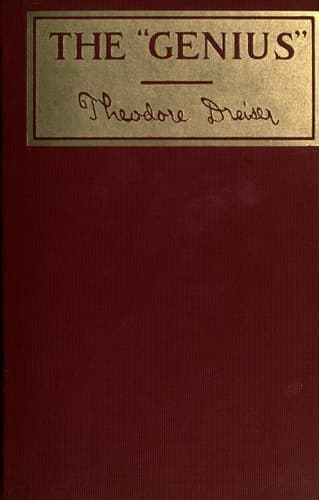
Artists -- Relations with women -- Fiction; Artists -- United States -- Fiction
work-horse job, with only silly material details like furniture and
houses and steel cars and stores all involved in a struggle for what? To
make a habitation for more shabby humanity? Never! To make a habitation
for beauty? Certainly! What beauty? The beauty of old age?--How silly!
The beauty of middle age? Nonsense! The beauty of maturity? No! The
beauty of youth? Yes. The beauty of eighteen. No more and no less. That
was the standard, and the history of the world proved it. Art,
literature, romance, history, poetry--if they did not turn on this and
the lure of this and the wars and sins because of this, what did they
turn on? He was for beauty. The history of the world justified him. Who
could deny it?
CHAPTER XVII
From Biloxi, because of the approach of summer when it would be
unbearably warm there, and because his funds were so low that it was
necessary to make a decisive move of some kind whether it led to
complete disaster or not, he decided to return to New York. In storage
with Kellners (M. Charles had kindly volunteered to take care of them
for him) were a number of the pictures left over from the original show,
and nearly all the paintings of the Paris exhibition. The latter had not
sold well. Eugene's idea was that he could slip into New York quietly,
take a room in some side street or in Jersey City or Brooklyn where he
would not be seen, have the pictures in the possession of M. Charles
returned to him, and see if he could not get some of the minor art
dealers or speculators of whom he had heard to come and look at them and
buy them outright. Failing that, he might take them himself, one by one,
to different dealers here and there and dispose of them. He remembered
now that Eberhard Zang had, through Norma Whitmore, asked him to come
and see him. He fancied that, as Kellners had been so interested, and
the newspaper critics had spoken of him so kindly the smaller dealers
would be eager to take up with him. Surely they would buy this material.
It was exceptional--very. Why not?
Eugene forgot or did not know the metaphysical side of prosperity and
failure. He did not realize that "as a man thinketh so is he," and so
also is the estimate of the whole world at the time he is thinking of
himself thus--not as he is but as he thinks he is. The sense of it is
abroad--by what processes we know not, but so it is.
Public-domain text, read in full here on John Shaqi.
Reviews
Reviews
No reviews yet
Be the first to share your thoughts on this work.
Elsewhere in the archive
Join the Discussion
Join the discussion
Sign in to leave a comment or review.
Sign InorCreate an account