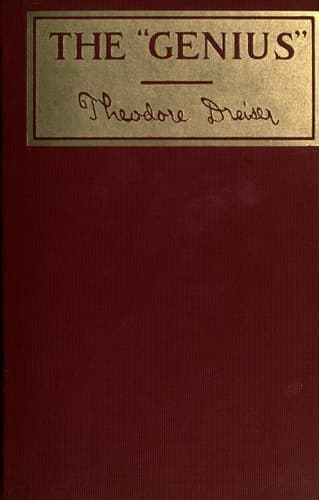
Artists -- Relations with women -- Fiction; Artists -- United States -- Fiction
Work is hard to get under the most favorable conditions of health and
youth and ambition, and the difficulties of obtaining it under
unfavorable ones need not be insisted on. Imagine if you can the crowds
of men, forty, fifty, one hundred strong, that wait at the door of every
drygoods employment office, every street-car registration bureau, on the
special days set aside for considering applications, at every factory,
shop or office where an advertisement calling for a certain type of man
or woman was inserted in the newspapers. On a few occasions that Eugene
tried or attempted to try, he found himself preceded by peculiar groups
of individuals who eyed him curiously as he approached, wondering, as he
thought, whether a man of his type could be coming to apply for a job.
They seemed radically different from himself to his mind, men with
little education and a grim consciousness of the difficulties of life;
young men, vapid looking men, shabby, stale, discouraged types--men who,
like himself, looked as though they had seen something very much better,
and men who looked as though they had seen things a great deal worse.
The evidence which frightened him was the presence of a group of bright,
healthy, eager looking boys of nineteen, twenty, twenty-one and
twenty-two who, like himself when he first went to Chicago years before,
were everywhere he went. When he drew near he invariably found it
impossible to indicate in any way that he was looking for anything. He
couldn't. His courage failed him; he felt that he looked too superior;
self-consciousness and shame overcame him.
He learned now that men rose as early as four o'clock in the morning to
buy a newspaper and ran quickly to the address mentioned in order to get
the place at the head of the line, thus getting the first consideration
as an applicant. He learned that some other men, such as waiters, cooks,
hotel employees and so on, frequently stayed up all night in order to
buy a paper at two in the morning, winter or summer, rain or snow, heat
or cold, and hurry to the promising addresses they might find. He
learned that the crowds of applicants were apt to become surly or
sarcastic or contentious as their individual chances were jeopardized by
ever-increasing numbers. And all this was going on all the time, in
winter or summer, heat or cold, rain or snow. Pretending interest as a
spectator, he would sometimes stand and watch, hearing the ribald jests,
the slurs cast upon life, fortune, individuals in particular and in
general by those who were wearily or hopelessly waiting. It was a
horrible picture to him in his present condition. It was like the
grinding of the millstones, upper and nether. These were the chaff. He
was a part of the chaff at present, or in danger of becoming so. Life
was winnowing him out. He might go down, down, and there might never be
an opportunity for him to rise any more.
Public-domain text, read in full here on John Shaqi.
Reviews
Reviews
No reviews yet
Be the first to share your thoughts on this work.
Elsewhere in the archive
Join the Discussion
Join the discussion
Sign in to leave a comment or review.
Sign InorCreate an account