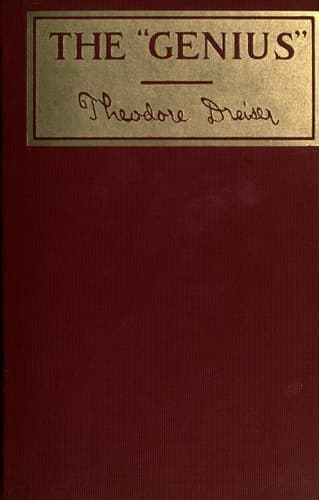
Artists -- Relations with women -- Fiction; Artists -- United States -- Fiction
It is a question how long this aimless, nervous wandering would have
continued if it had not been for the accidental recollection of an
experience which a fellow artist once related to him of a writer who had
found himself nervously depressed and who, by application to the
president of a railroad, had secured as a courtesy to the profession
which he represented so ably a position as an apprentice in a surveying
corps, being given transportation to a distant section of the country
and employed at a laborer's wages until he was well. Eugene now thought
of this as quite an idea for himself. Why it had not occurred to him
before he did not know. He could apply as an artist--his appearance
would bear him out, and being able to speak from the vantage point of
personal ability temporarily embarrassed by ill health, his chances of
getting something would be so much better. It would not be the same as a
position which he had secured for himself without fear or favor, but it
would be a position, different from farming with Angela's father because
it would command a salary.
CHAPTER XIX
This idea of appealing to the president of one of the great railroads
that entered New York was not so difficult to execute. Eugene dressed
himself very carefully the next morning, and going to the office of the
company in Forty-second Street, consulted the list of officers posted in
one of the halls, and finding the president to be on the third floor,
ascended. He discovered, after compelling himself by sheer will power to
enter, that this so-called office was a mere anteroom to a force of
assistants serving the president, and that no one could see him except
by appointment.
"You might see his secretary if he isn't busy," suggested the clerk who
handled his card gingerly.
Eugene was for the moment undetermined what to do but decided that maybe
the secretary could help him. He asked that his card might be taken to
him and that no explanation be demanded of him except by the secretary
in person. The latter came out after a while, an under secretary of
perhaps twenty-eight years of age, short and stout. He was bland and
apparently good natured.
"What is it I can do for you?" he asked.
Eugene had been formulating his request in his mind--some method of
putting it briefly and simply.
"I came up to see Mr. Wilson," he said, "to see if he would not send me
out as a day-laborer of some kind in connection with some department of
the road. I am an artist by profession and I am suffering from
neurasthenia. All the doctors I have consulted have recommended that I
get a simple, manual position of some kind and work at it until I am
well. I know of an instance in which Mr. Wilson, assisted, in this way,
Mr. Savin the author, and I thought he might be willing to interest
himself in my case."
Public-domain text, read in full here on John Shaqi.
Reviews
Reviews
No reviews yet
Be the first to share your thoughts on this work.
Elsewhere in the archive
Join the Discussion
Join the discussion
Sign in to leave a comment or review.
Sign InorCreate an account