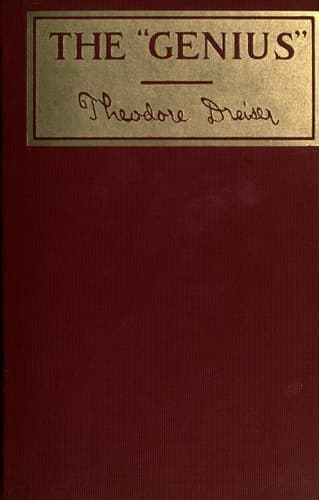
Artists -- Relations with women -- Fiction; Artists -- United States -- Fiction
It was thus that Eugene floundered to and fro, and it was in this state,
brooding and melancholy, that Angela found him on her arrival. He was as
gay as ever at times, when he was not thinking, but he was very thin and
hollow-eyed, and Angela fancied that it was overwork and worry which
kept him in this state. Why had she left him? Poor Eugene! She had clung
desperately to the money he had given her, and had most of it with her
ready to be expended now for his care. She was so anxious for his
recovery and his peace of mind that she was ready to go to work herself
at anything she could find, in order to make his path more easy. She was
thinking that fate was terribly unjust to him, and when he had gone to
sleep beside her the first night she lay awake and cried. Poor Eugene!
To think he should be tried so by fate. Nevertheless, he should not be
tortured by anything which she could prevent. She was going to make him
as comfortable and happy as she could. She set about to find some nice
little apartment or rooms where they could live in peace and where she
could cook Eugene's meals for him. She fancied that maybe his food had
not been exactly right, and when she got him where she could manifest a
pretence of self-confidence and courage that he would take courage from
her and grow better. So she set briskly about her task, honeying Eugene
the while, for she was confident that this above all things was the
thing he needed. She little suspected what a farce it all appeared to
him, how mean and contemptible he appeared to himself. He did not care
to be mean--to rapidly disillusion her and go his way; and yet this dual
existence sickened him. He could not help but feel that from a great
many points of view Angela was better than Carlotta. Yet the other woman
was wider in her outlook, more gracious in her appearance, more
commanding, more subtle. She was a princess of the world, subtle, deadly
Machiavellian, but a princess nevertheless. Angela was better described
by the current and acceptable phrase of the time--a "thoroughly good
woman," honest, energetic, resourceful, in all things obedient to the
race spirit and the conventional feelings of the time. He knew that
society would support her thoroughly and condemn Carlotta, and yet
Carlotta interested him more. He wished that he might have both and no
fussing. Then all would be beautiful. So he thought.
CHAPTER XXVI
Public-domain text, read in full here on John Shaqi.
Reviews
Reviews
No reviews yet
Be the first to share your thoughts on this work.
Elsewhere in the archive
Join the Discussion
Join the discussion
Sign in to leave a comment or review.
Sign InorCreate an account