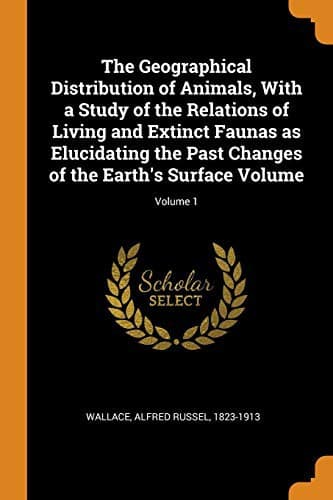
The Geographical Distribution of Animals, Volume 1: With a study of the relations of living and extinct faunas as elucidating the past changes of the Earth's surfaceWallace, Alfred Russel
Science
The Geographical Distribution of Animals, Volume 1: With a study of the relations of living and extinct faunas as elucidating the past changes of the Earth's surface
Wallace, Alfred Russel
Paleontology; Zoogeography
In the Miocene formations we find the Feline type well developed. The
wonderful _Machairodus_, which in Europe lived down to Post-Pliocene times,
is found in the Upper Miocene of Dakota; and perfect crania have been
discovered, showing that the chin was lengthened downwards to receive and
protect the enormous canines. _Dinyctis_ was allied both to _Machairodus_
and to the weasels. Three new genera have been lately described by
Professor Cope from the Miocene of Colorado,--_Bunælurus_, with characters
of both cats and weasels; _Daptophilus_, allied to _Dinyctis_; and
_Hoplophoneus_, more allied to _Machairodus_. The Canidæ are represented by
_Amphicyon_, which occurs in deposits of the same age in Europe; and by
_Canis_, four species of which genus are recorded by Professor Cope from
the Miocene of Colorado, and it also occurs in the Pliocene. The _Hyænodon_
is represented by three species in the Miocene of Dakota and Colorado. It
occurs {135}also in the European Miocene and Upper Eocene formations, and
constitutes a distinct family Hyænodontidæ, allied, according to Dr. Leidy,
to wolves, cats, hyænas and weasels. The Ursidæ are represented by only one
species of an extinct genus, _Leptarchus_, from the Pliocene of Nebraska.
From the Pliocene of Colorado, Prof. Cope has recently described
_Tomarctos_, as a "short-faced type of dog;" well as species of _Canis_ and
_Martes_.
_Ungulata._--The animals belonging to this order being usually of large
size and accustomed to feed and travel in herds, are liable to wholesale
destruction by floods, bogs, precipices, drought or hunger. It is for these
reasons, probably, that their remains are almost always more numerous than
those of other orders of mammalia. In America they are especially abundant;
and the number of new and intermediate types about whose position there is
much difference of opinion among Palæontologists, renders it very difficult
to give a connected summary of them with any approach to systematic
accuracy.
Public-domain text, read in full here on John Shaqi.
Reviews
Reviews
No reviews yet
Be the first to share your thoughts on this work.
Elsewhere in the archive
Join the Discussion
Join the discussion
Sign in to leave a comment or review.
Sign InorCreate an account