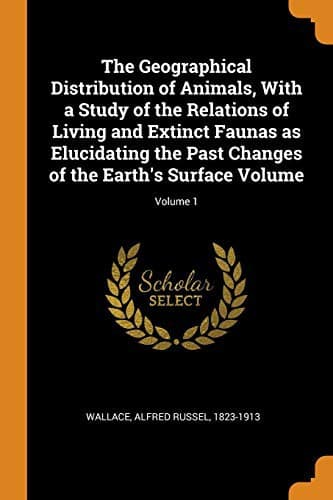
The Geographical Distribution of Animals, Volume 1: With a study of the relations of living and extinct faunas as elucidating the past changes of the Earth's surfaceWallace, Alfred Russel
Science
The Geographical Distribution of Animals, Volume 1: With a study of the relations of living and extinct faunas as elucidating the past changes of the Earth's surface
Wallace, Alfred Russel
Paleontology; Zoogeography
These facts may be due, in part, to a want of strict co-ordination between
the Tertiary deposits of Europe and North America,--in part to the
imperfection of the record in the latter country. Yet it does not seem
probable that they are altogether due South America and well marked
differences to imperfect knowledge; yet we find such important families as
the Civets, Hyænas, Giraffes, and Hippopotami absent from America, with the
Weasels, and Antelopes almost so; while America possesses almost all the
Camelidæ, two peculiar orders, Dinocerata and Tillodontia, and four
remarkably peculiar families, Limnotheridæ, Lemuravidæ, Oreodontidæ and
Brontotheridæ. If then the facts at present known represent approximately
the real time-relations of the groups in question on the two continents,
they render it probable that weasels, bears, true horses, swine, oxen,
sheep and antelopes, originated on the Old World continent, and were
transmitted to America during some part of the Miocene period; while camels
originated in the New World, and somewhere about the same time passed over
to Europe. Of the extinct families common to the two hemispheres, the
Anthracotheridæ alone seem to have had an American origin. Of the genera
common to the two countries, almost all seem to have had a European origin,
the only genera of equal date being the two rhinoceroses and three
Anchitheridæ; but if the Brontotheridæ are allied to the Rhinocerotidæ,
these latter may have originated in America, although now an exclusively
Old World type. These conclusions are not improbable when we consider the
much greater size of the Old World continents, extending far into the
tropics and probably {143}always more or less united to the tropical areas;
while the evidence of the extinct mammalia themselves shows, that South
America has been for the most part isolated from the northern continent,
and did not take part in the development of its characteristic Tertiary
fauna.
Before speculating further on this subject, it will be well to lay before
our readers a summary of South American palæontology, after which we shall
be in a better position to draw correct inferences from the whole body of
the evidence.
SOUTH AMERICA.
Unfortunately, our knowledge of the interesting fossil fauna of this
continent, is almost wholly confined to the Post-Pliocene and Pliocene
periods. A few remains have been discovered in deposits believed to be of
Eocene age, but nothing whatever representing the vast intervening period,
so rich in peculiar forms of animal life both in North America and Europe.
Public-domain text, read in full here on John Shaqi.
Reviews
Reviews
No reviews yet
Be the first to share your thoughts on this work.
Elsewhere in the archive
Join the Discussion
Join the discussion
Sign in to leave a comment or review.
Sign InorCreate an account