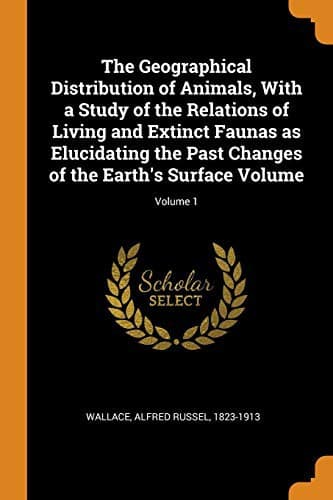
The Geographical Distribution of Animals, Volume 1: With a study of the relations of living and extinct faunas as elucidating the past changes of the Earth's surfaceWallace, Alfred Russel
Science
The Geographical Distribution of Animals, Volume 1: With a study of the relations of living and extinct faunas as elucidating the past changes of the Earth's surface
Wallace, Alfred Russel
Paleontology; Zoogeography
The preceding sketch of the wonderful cave fauna of Central Brazil, is
sufficient to show that it represents, in the main, a period of great
antiquity. Not only are almost the whole of the species extinct, but there
are twenty extinct genera, and three others not now inhabitants of South
America. The fact that so few remains of the living animals of the country
are found in these caves, indicates that some change of physical conditions
has occurred since they were the receptacles of so many of the larger
animals; and the presence of many extinct genera of {146}large size,
especially among the Edentata and American families of Rodents, are
additional proofs of a very high antiquity. Yet many of these cave animals
are closely allied to those which are found in North America in the
Post-Pliocene deposits only, so that we have no reason to suppose the
cave-fauna to be of much earlier date. But the great amount of organic
change it implies, must give us an enlarged idea of the vast periods of
time, as measured by years, which are included in this, the most recent of
all geological epochs.
_Pliocene Period of Temperate South America._--We have now to consider the
numerous remains of extinct animals found in various deposits in the
Pampas, and in Patagonia, and a few in Bolivia. The age of these is
uncertain; but as they are very similar to the cave-fauna, though
containing a somewhat larger proportion of extinct genera and some very
remarkable new forms, they cannot be _very_ much older, and are perhaps
best referred at present to the newer portion of the Pliocene formation.
_Carnivora._--The genus _Machairodus_ or sabre-toothed tigers, represents
the Felidæ. There are several species of wolves (_Canis_); a weasel
(_Mustela_); two bears of the Brazilian cave-genus _Arctotherium_; and the
extinct European genus _Hyænarctos_.
_Ungulata._--There are two species of _Equus_, found in the Pampas, Chili,
and Bolivia; two of _Macrauchenia_, an extraordinary extinct group allied
to the tapir and _Palæotherium_, but with the long neck, and general size
of a camel. A second species found on the highlands of Bolivia is much
smaller.
A more recent discovery, in Patagonia, is the almost perfect series of
teeth of a large animal named _Homalodontotherium_; and which is believed
by Professor Flower, who has described it, to have been allied to
_Rhinoceros_, and still more to the Miocene _Hyracodon_ from North America;
and also to present some resemblances to _Macrauchenia_, and though much
more remotely, to the curious genus _Nesodon_ mentioned further on.
Public-domain text, read in full here on John Shaqi.
Reviews
Reviews
No reviews yet
Be the first to share your thoughts on this work.
Elsewhere in the archive
Join the Discussion
Join the discussion
Sign in to leave a comment or review.
Sign InorCreate an account