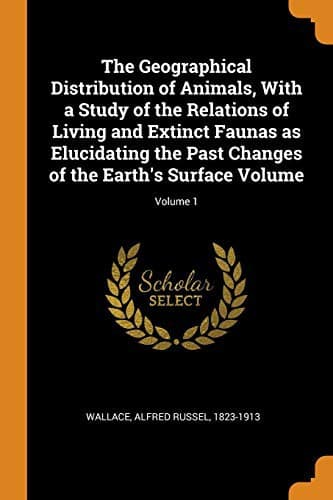
The Geographical Distribution of Animals, Volume 1: With a study of the relations of living and extinct faunas as elucidating the past changes of the Earth's surfaceWallace, Alfred Russel
Science
The Geographical Distribution of Animals, Volume 1: With a study of the relations of living and extinct faunas as elucidating the past changes of the Earth's surface
Wallace, Alfred Russel
Paleontology; Zoogeography
It is clear that so complete and sudden a change in the higher forms of
life, does not represent the normal state of things. Species and genera
have not, at all times, become so rapidly extinct. The time occupied by the
"Recent period," that is the {150}time _since_ these changes took place is,
geologically, minute. The time of the whole of the Post-Pliocene period, as
measured by the amount of physical and _general_ organic change known to
have taken place, is exceedingly small when compared with the duration of
the Pliocene period, and still smaller, probably, as compared with the
Miocene. Yet during these two periods we meet with no such break in the
continuity of the forms of life, no such radical change in the _character_
of the fauna (though the number of specific and generic changes may be as
great) as we find in passing from the Post-Pliocene to recent times. For
example, in Central Europe numerous hyænas, rhinoceroses, and antelopes,
with the great _Machairodus_, continued from Miocene all through Pliocene
into Post-Pliocene times; while hippopotami and elephants continued to live
through a good part of the Pliocene and Post-Pliocene periods,--and then
all suddenly became extinct or left the country. In North America there has
been more movement of the fauna in all the periods; but we have similar
great felines, horses, mastodons, and elephants, in the Pliocene and
Post-Pliocene periods, while _Rhinoceros_ is common to the Miocene and
Pliocene, and camels range continuously from Miocene, through Pliocene, to
Post-Pliocene times;--when all alike became extinct. Even in South America
the evidence is, as far as it goes, all the same way. We find
_Machairodus_, _Equus_, _Mastodon_, _Megatherium_, _Scelidotherium_,
_Megalonyx_, and numerous gigantic armadillos, alike in the caves and in
the stratified tertiary deposits of the Pampas;--yet all have since passed
away.
Public-domain text, read in full here on John Shaqi.
Reviews
Reviews
No reviews yet
Be the first to share your thoughts on this work.
Elsewhere in the archive
Join the Discussion
Join the discussion
Sign in to leave a comment or review.
Sign InorCreate an account