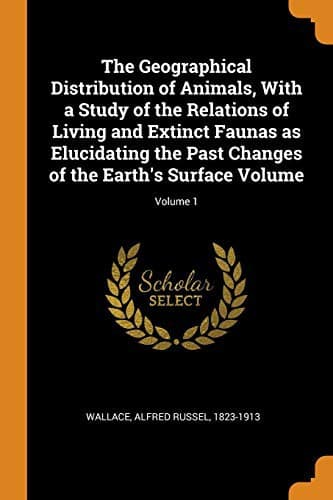
The Geographical Distribution of Animals, Volume 1: With a study of the relations of living and extinct faunas as elucidating the past changes of the Earth's surfaceWallace, Alfred Russel
Science
The Geographical Distribution of Animals, Volume 1: With a study of the relations of living and extinct faunas as elucidating the past changes of the Earth's surface
Wallace, Alfred Russel
Paleontology; Zoogeography
Without venturing to decide which of these various theories will be
ultimately proved to be correct, we may state, that there is an increasing
belief among geologists in the long duration of this ice-period, and the
vast extent and great thickness attained by the ice-sheet. One of the most
recent, and not the least able, of the writers on this question (Mr. Belt)
shows strong reasons for adopting the view that the ice-period was
simultaneous in both hemispheres; and he calculates that the vast amount of
water abstracted from the ocean and locked up {152}in mountains of ice
around the two poles, would lower the general level of the ocean about
2,000 feet. This would be equivalent to a general elevation of the land to
the same amount, and would thus tend to intensify the cold; and this
elevation may enable us to understand the recent discoveries of signs of
glacial action at moderate elevations in Central America and Brazil, far
within the tropics. At the same time, the weight of ice piled up in the
north would cause the land surface to sink there, perhaps unequally,
according to the varying nature of the interior crust of the earth; and
since the weight has been removed land would rise again, still somewhat
irregularly; and thus the phenomena of raised beds of arctic shells in
temperate latitudes, are explained.
Now, it is evident, that the phenomena we have been considering--of the
recent changes of the mammalian fauna in Europe, North America, South
Temperate America, and the highlands of Brazil--are such as might be
explained by the most extreme views as to the extent and vastness of the
ice-sheet, and especially as to its simultaneous occurrence in the northern
and southern hemispheres; and where two such completely independent sets of
facts are found to combine harmoniously, and supplement each other on a
particular hypothesis, the evidence in favour of that hypothesis is greatly
strengthened. An objection that will occur to zoologists, may here be
noticed. If the Glacial epoch extended over so much of the temperate and
even parts of the tropical zone, and led to the extinction of so many forms
of life even within the tropics, how is it that so much of the purely
tropical fauna of South America has maintained itself, and that there are
still such a vast number of forms, both of mammalia, birds, reptiles, and
insects, that seem organized for an exclusive existence in tropical
forests? Now Mr. Belt's theory, of the subsidence of the ocean to the
extent of about 2,000 feet, supplies an answer to this objection; for we
should thus have a tract of lowland of an average width of some hundreds of
miles, added to the whole east coast of Central and South America. This
tract would, no doubt, become covered with forests as it was slowly formed,
would enjoy a perfectly {153}tropical climate, and would thus afford an
ample area for the continued existence and development of the typical South
Public-domain text, read in full here on John Shaqi.
Reviews
Reviews
No reviews yet
Be the first to share your thoughts on this work.
Elsewhere in the archive
Join the Discussion
Join the discussion
Sign in to leave a comment or review.
Sign InorCreate an account