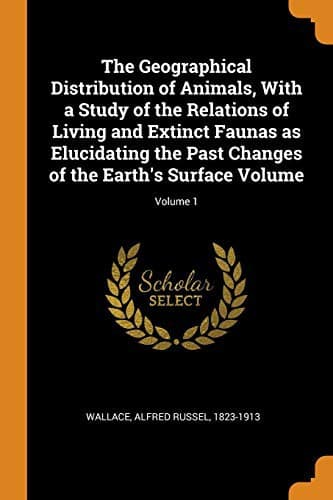
The Geographical Distribution of Animals, Volume 1: With a study of the relations of living and extinct faunas as elucidating the past changes of the Earth's surfaceWallace, Alfred Russel
Science
The Geographical Distribution of Animals, Volume 1: With a study of the relations of living and extinct faunas as elucidating the past changes of the Earth's surface
Wallace, Alfred Russel
Paleontology; Zoogeography
_South America._--The caverns of Brazil produced thirty-four species of
birds, most of them referable to Brazilian genera, and many to still
existing species. The most interesting were two species of American ostrich
(_Rhea_), one larger than either of the living species; a large
turkey-buzzard (_Cathartes_); a new species of the very isolated South
American genus _Opisthocomus_; and a _Cariama_, or allied new genus.
_Madagascar and the Mascarene Islands._--We have here only evidence of
birds that have become extinct in the historical period or very little
earlier. First we have a group of birds incapable of flight, allied to
pigeons, but forming a separate family, _Dididæ_; and which, so far as we
yet know, inhabited Mauritius, Rodriguez, and probably Bourbon.
_Aphanapteryx_, an extinct genus of rails, inhabited Mauritius; and another
genus, (_Erythromachus_), Rodriguez. A large parrot, said by Prof. Milne
Edwards to be allied to _Ara_ and _Microglossus_, also inhabited Mauritius;
and another allied to _Eclectus_, the island of Rodriguez. None of these
have been found in Madagascar; but a gigantic Struthious bird, _Æpyornis_,
forming a peculiar family distinct both from the ostriches of Africa and
the _Dinornis_ of New Zealand inhabited that island; and there is reason to
believe that this may have lived less than 200 years ago.
_New Zealand._--A number of extinct Struthious birds, forming two families,
_Dinornithidæ_ and _Palapterygidæ_, have been found in New Zealand. Some
were of gigantic size. They seem allied both to the living _Apteryx_ of New
Zealand and the emu of Australia. They are quite recent, and some of them
have probably lived within the last few centuries. Remains of _Dinornis_
have also been found in a Post-Pliocene deposit in Queensland, N. E.
Australia[5]--a very important discovery, as it {165}gives support to the
theory of a great eastward extension of Australia in Tertiary times.
EXTINCT TERTIARY REPTILES.
These will not occupy us long, as no very great number are known, and most
of them belong to a few principal forms of comparatively little
geographical interest.
Tortoises are perhaps the most abundant of the Tertiary reptiles. They are
numerous in the Eocene and Miocene formations both in Europe and North
America. The genera _Emys_ and _Trionyx_ abound in both countries, as well
as in the Miocene of India. Land tortoises occur in the Eocene of North
America and in the Miocene of Europe and India, where the huge
_Colossochelys_, twelve feet long, has been found. In the Pliocene deposits
of Switzerland the living American genus _Chelydra_ has been met with.
These facts, together with the occurrence of a living _species_ in the
Miocene of India, show that this order of reptiles is of great antiquity,
and that most of the genera once had a wider range than now.
Public-domain text, read in full here on John Shaqi.
Reviews
Reviews
No reviews yet
Be the first to share your thoughts on this work.
Elsewhere in the archive
Join the Discussion
Join the discussion
Sign in to leave a comment or review.
Sign InorCreate an account