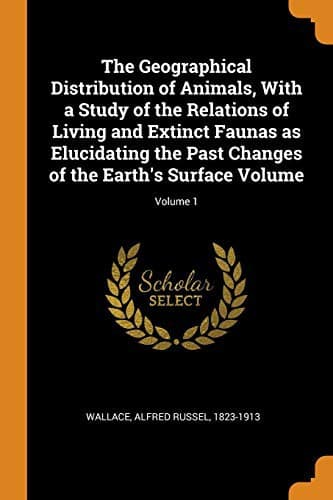
The Geographical Distribution of Animals, Volume 1: With a study of the relations of living and extinct faunas as elucidating the past changes of the Earth's surfaceWallace, Alfred Russel
Science
The Geographical Distribution of Animals, Volume 1: With a study of the relations of living and extinct faunas as elucidating the past changes of the Earth's surface
Wallace, Alfred Russel
Paleontology; Zoogeography
The remains of land and fresh-water shells are not much more frequent than
those of insects. Like them, too, their forms are very stable, continuing
unchanged through several geological {169}periods. In the Pliocene and
Miocene formations, most of the shells are very similar to living species,
and some are quite identical. In the Eocene we meet with ordinary forms of
the genera _Helix_, _Clausilia_, _Pupa_, _Bulimus_, _Glandina_,
_Cyclostoma_, _Megalostoma_, _Planorbis_, _Paludina_ and _Limnæa_, some
resembling European species, others more like tropical forms. A British
Eocene species of _Helix_ is still living in Texas; and in the South of
France are found species of the Brazilian sub-genera _Megaspira_ and
_Anastoma_. In the secondary formation no true land shells have been found,
but fresh water shells are tolerably abundant, and almost all are still of
living forms. In the Wealden (Lower Cretaceous) and Purbeck (Upper Oolite)
are found _Unio_, _Melania_, _Paludina_, _Planorbis_, and _Limnæa_; while
the last named genus occurs even in the Lias.
The notion that land shells were really not in existence during the
secondary period is, however, proved to be erroneous by the startling
discovery, in the Palæozoic coal measures of Nova Scotia, of two species of
Helicidæ, both of living genera--_Pupa vetusta_, and _Zonites priscus_.
They have been found in the hollow trunk of a _Sigillaria_, and in great
quantities in a bed full of Stigmarian rootlets. The most minute
examination detects no important differences of form or of microscopic
structure, between these shells and living species of the same genera!
These mollusca were the contemporaries of Labyrinthodonts and strange
Ganoid fishes, which formed almost the whole vertebrate fauna. This
unexpected discovery renders it almost certain, that numbers of other
existing genera, of which we have found no traces, lived with these two
through the whole secondary period; and we are thus obliged to assume as a
probability, that any particular genus has lived through a long succession
of geological ages. In estimating the importance of any peculiarities or
anomalies in the geographical distribution of land shells as compared with
the higher vertebrates, we shall, therefore, have to keep this possible,
and even probable high antiquity, constantly in mind.
Public-domain text, read in full here on John Shaqi.
Reviews
Reviews
No reviews yet
Be the first to share your thoughts on this work.
Elsewhere in the archive
Join the Discussion
Join the discussion
Sign in to leave a comment or review.
Sign InorCreate an account