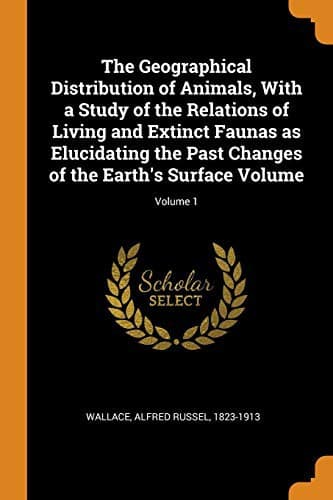
The Geographical Distribution of Animals, Volume 1: With a study of the relations of living and extinct faunas as elucidating the past changes of the Earth's surfaceWallace, Alfred Russel
Science
The Geographical Distribution of Animals, Volume 1: With a study of the relations of living and extinct faunas as elucidating the past changes of the Earth's surface
Wallace, Alfred Russel
Paleontology; Zoogeography
This is by far the richest portion of the Palæarctic region, for although
of moderate extent much of it enjoys a climate in which the rigours of
winter are almost unknown. It includes all the countries south of the
Pyrenees, Alps, Balkans, and Caucasus mountains; all the southern shores of
the Mediterranean to the Atlas range, and even beyond it to include the
extra-tropical portion of the Sahara; and in the Nile valley as far as the
second cataract. Further east it includes the northern half of Arabia and
the whole of Persia, as well as Beluchistan, and perhaps Affghanistan up to
the banks of the Indus. This extensive district is almost wholly a region
of mountains and elevated plateaus. On the west, Spain is mainly a
table-land of more than 2000 feet elevation, deeply penetrated by extensive
valleys and rising into lofty mountain chains. Italy, Corsica, Sardinia,
and Sicily, are all very {200}mountainous, and much of their surface
considerably elevated. Further east we have all European Turkey and Greece,
a mountain region with a comparatively small extent of level plain. In Asia
the whole country, from Smyrna through Armenia and Persia to the further
borders of Affghanistan, is a vast mountainous plateau, almost all above
2000, and extensive districts above 5000 feet in elevation. The only large
tract of low-land is the valley of the Euphrates. There is also some
low-land south of the Caucasus, and in Syria the valley of the Jordan. In
North Africa the valley of the Nile and the coast plains of Tripoli and
Algiers are almost the only exceptions to the more or less mountainous and
plateau-like character of the country. Much of this extensive area is now
bare and arid, and often even of a desert character; a fact no doubt due,
in great part, to the destruction of aboriginal forests. This loss is
rendered permanent by the absence of irrigation, and, it is also thought,
by the abundance of camels and goats, animals which are exceedingly
injurious to woody vegetation, and are able to keep down the natural growth
of forests. Mr. Marsh (whose valuable work _Man and Nature_ gives much
information on this subject) believes that even large portions of the
African and Asiatic deserts would become covered with woods, and the
climate thereby greatly improved, were they protected from these
destructive domestic animals, which are probably not indigenous to the
country. Spain, in proportion to its extent, is very barren; Italy and
European Turkey are more woody and luxuriant; but it is perhaps in Asia
Minor, on the range of the Taurus, along the shores of the Black Sea, and
to the south of the Caucasus range, that this sub-region attains its
maximum of luxuriance in vegetation and in animal life. From the Caspian
eastward extends a region of arid plains and barren deserts, diversified by
a few more fertile valleys, in which the characteristic flora and fauna of
this portion of the Palæarctic region abounds. Further east we come to the
Public-domain text, read in full here on John Shaqi.
Reviews
Reviews
No reviews yet
Be the first to share your thoughts on this work.
Elsewhere in the archive
Join the Discussion
Join the discussion
Sign in to leave a comment or review.
Sign InorCreate an account