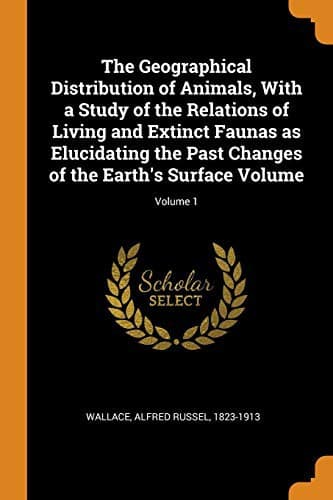
The Geographical Distribution of Animals, Volume 1: With a study of the relations of living and extinct faunas as elucidating the past changes of the Earth's surfaceWallace, Alfred Russel
Science
The Geographical Distribution of Animals, Volume 1: With a study of the relations of living and extinct faunas as elucidating the past changes of the Earth's surface
Wallace, Alfred Russel
Paleontology; Zoogeography
The superficial aspects of this vast territory, as determined by its
vegetable covering, are very striking and well contrasted. A broad tract on
the northern coast, varying from 150 to 300 and even 500 miles wide, is
occupied by the Tundras or barrens, where nothing grows but mosses and the
dwarfest Arctic plants, and where the ground is permanently frozen to a
great depth. This tract has its greatest southern extension between the
rivers Obi and Yenesi, where it reaches the parallel of 60° north latitude.
Next to this comes a vast extent of northern forests, mostly of conifers in
the more northern and lofty situations, while deciduous trees preponderate
in the southern portions and in the more sheltered valleys. The greatest
extension of this forest region is north of Lake Baikal, where it is more
than 1,200 miles wide. These forests extend along the mountain ranges to
join those of the Hindu Koosh. South of the forests the remainder of the
sub-region consists of open pasture-lands and vast intervening deserts, of
which the Gobi, and those of Turkestan between the Aral and Balkash lakes,
are the most {217}extensive. The former is nearly 1,000 miles long, with a
width of from 200 to 350 miles, and is almost as complete a desert as the
Sahara.
With very few exceptions, this vast territory is exposed to an extreme
climate, inimical to animal life. All the lower parts being situated to the
north, have an excessively cold winter, so that the limit of constantly
frozen ground descends below the parallel of 60° north latitude. To the
south, the land is greatly elevated, and the climate extremely dry. In
summer the heat is excessive, while the winter is almost as severe as
further north. The whole country, too, is subject to violent storms, both
in summer and winter; and the rich vegetation that clothes the steppes in
spring, is soon parched up and replaced by dusty plains. Under these
adverse influences we cannot expect animal life to be so abundant as in
those sub-regions subject to more favourable physical conditions; yet the
country is so extensive and so varied, that it does actually, as we shall
see, possess a very considerable and interesting fauna.
Public-domain text, read in full here on John Shaqi.
Reviews
Reviews
No reviews yet
Be the first to share your thoughts on this work.
Elsewhere in the archive
Join the Discussion
Join the discussion
Sign in to leave a comment or review.
Sign InorCreate an account