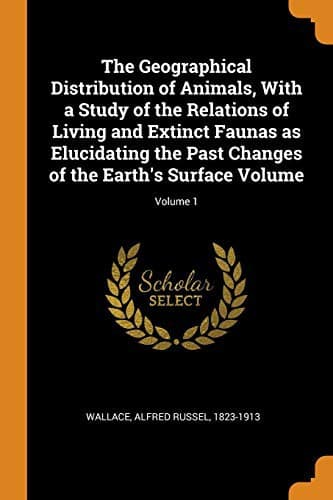
The Geographical Distribution of Animals, Volume 1: With a study of the relations of living and extinct faunas as elucidating the past changes of the Earth's surfaceWallace, Alfred Russel
Science
The Geographical Distribution of Animals, Volume 1: With a study of the relations of living and extinct faunas as elucidating the past changes of the Earth's surface
Wallace, Alfred Russel
Paleontology; Zoogeography
During the period we have been considering, the ancestors of existing apes
and monkeys flourished (as we have seen in Chapter VI.) along the whole
southern shores of the old Palæarctic continent; and it seems likely that
they first entered Africa by means of a land connection indicated by the
extensive and lofty plateaus of the Sahara, situated to the south-east of
Tunis and reaching to a little north-west of Lake Tchad; and at the same
time the elephant and rhinoceros type may have entered. This will account
for the curious similarity between the higher faunas of West Africa and the
Indo-Malay sub-region, for owing to the present distribution of land and
sea and the narrowing of the tropical zone since Miocene times, these are
now the only lowland, equatorial, forest-clad countries, which were in
connection with the southern shores of the old Palæarctic continent at the
time of its greatest luxuriance and development. This western connection
did not probably last long, the junction that led to the greatest incursion
of new forms, and the complete change in the character of the African
fauna, having apparently been effected by way of Syria and the shores of
the Red Sea at a somewhat later date. By this route the old
South-Palæarctic fauna, indicated by the fossils of Pikermi and the Siwalik
Hills, poured into Africa; and finding there a new and favourable country,
almost wholly unoccupied by large Mammalia, increased to an enormous
extent, developed into new forms, and finally overran the whole continent.
Public-domain text, read in full here on John Shaqi.
Reviews
Reviews
No reviews yet
Be the first to share your thoughts on this work.
Elsewhere in the archive
Join the Discussion
Join the discussion
Sign in to leave a comment or review.
Sign InorCreate an account