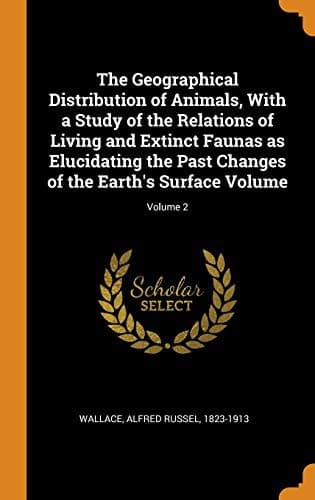
The Geographical Distribution of Animals, Volume 2: With a study of the relations of living and extinct faunas as elucidating the past changes of the Earth's surfaceWallace, Alfred Russel
Science
The Geographical Distribution of Animals, Volume 2: With a study of the relations of living and extinct faunas as elucidating the past changes of the Earth's surface
Wallace, Alfred Russel
Paleontology; Zoogeography
GENERAL DISTRIBUTION.
__________________________________/\__________________________________
/ \
NEOTROPICAL| NEARCTIC |PALÆARCTIC | ETHIOPIAN | ORIENTAL | AUSTRALIAN
SUB-REGIONS|SUB-REGIONS|SUB-REGIONS|SUB-REGIONS|SUB-REGIONS|SUB-REGIONS.
-----------+-----------+-----------+-----------+-----------+------------
| | | | |
-- 2. 3 -- |-- -- -- --|-- -- -- --|-- -- -- --|-- -- -- 4 |-- -- -- --
| | | | |
The Tapirs form a small group of animals whose discontinuous distribution
plainly indicates their approaching extinction. For a long time only two
species were known, the black American, and the white-banded Malay tapir,
the former confined to the equatorial forests of South America, the latter
to the Malay peninsula, Sumatra, and Borneo (Plate VIII. vol. i. p. 337).
Lately however another, or perhaps two distinct species (or according to
Dr. J. E. Gray, four!) have been discovered in the Andes of New Granada and
Ecuador, at an elevation of from 8,000 to 12,000 feet; while one or perhaps
two more, forming the allied genus _Elasmognathus_, have been found to
inhabit Central America from Panama to Guatemala.
_Extinct Tapirs._--True tapirs inhabited Western Europe, from the latest
Pliocene back to the earliest Miocene times; while they only occur in
either North or South America in the Post-pliocene deposits and caves. The
singular distribution of the living species is thus explained, since we see
that they are an Old World group which only entered the American continent
at a comparatively recent epoch. An ancestral form of this
group--_Lophiodon_--is found in Miocene and Eocene deposits of {213}Europe
and North America; while a still more ancient form of large size is found
in the Lower Eocene of France and England, indicating an immense antiquity
for this group of Mammalia. There are many other extinct forms connecting
these with the Palæotheridæ, already noticed in chapter vi. (vol. i. pp.
119-125).
FAMILY 45.--RHINOCEROTIDÆ. (1 Genus, 9 Species.)
Public-domain text, read in full here on John Shaqi.
Reviews
Reviews
No reviews yet
Be the first to share your thoughts on this work.
Elsewhere in the archive
Join the Discussion
Join the discussion
Sign in to leave a comment or review.
Sign InorCreate an account