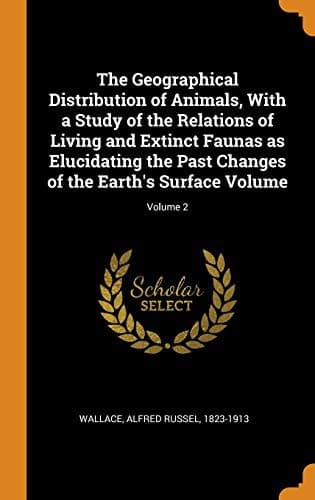
The Geographical Distribution of Animals, Volume 2: With a study of the relations of living and extinct faunas as elucidating the past changes of the Earth's surfaceWallace, Alfred Russel
Science
The Geographical Distribution of Animals, Volume 2: With a study of the relations of living and extinct faunas as elucidating the past changes of the Earth's surface
Wallace, Alfred Russel
Paleontology; Zoogeography
The Paradiseidæ, or "Birds of Paradise," form one of the most remarkable
families of birds, unsurpassed alike for the singularity and the beauty of
their plumage. Till recently the family was restricted to about eight
species of the more typical Paradise birds, but in his splendid monograph
of the group, Mr. Elliot has combined together a number of allied forms
which had been doubtfully placed in several adjacent families. The various
species of true Paradise birds, having ornamental plumes developed from
different parts of the body, are almost wholly confined to New Guinea and
the adjacent Papuan Islands, one species only being found in the Moluccas
and one in North Australia; while the less typical Bower-birds, having no
such developments of plumage, are most characteristic of the north and east
of Australia, with a few species in New Guinea. The distribution of the
genera according to Mr. Elliot's monograph is as follows:--
Sub-family I. Paradiseinæ.--_Paradisea_ (4 sp.), Papuan Islands;
_Manucodia_ (3 sp.), Papuan Islands and North Australia; _Astrapia_ (1
sp.), New Guinea; _Parotia_ (1 sp.), New Guinea; _Lophorhina_ (1 sp.), New
Guinea; _Diphyllodes_ (3 sp.), Papuan {275}Islands; _Xanthomelus_ (1 sp.),
New Guinea; _Cicinnurus_ (1 sp.), Papuan Islands; _Paradigalla_ (1 sp.),
New Guinea; _Semioptera_ (1 sp.), Gilolo and Batchian.
Sub-family II. Epimachinæ.--_Epimachus_ (1 sp.), New Guinea; _Drepanornis_
(1 sp.), New Guinea; _Seleucides_ (1 sp.), New Guinea (Plate X., Vol. I.,
p. 414); _Ptilorhis_ (4 sp.), New Guinea and North Australia.
Sub-family III. Tectonarchinæ (Bower-birds).--_Sericulus_ (1 sp.), Eastern
Australia; _Ptilonorhynchus_ (1 sp.), Eastern Australia; _Chlamydodera_ (4
sp.), North and East Australia; _Ælurædus_ (3 sp.), Papuan Islands and East
Australia; _Amblyornis_ (1 sp.), New Guinea.
FAMILY 22.--MELIPHAGIDÆ. (23 Genera, 190 Species.)
GENERAL DISTRIBUTION.
__________________________________/\__________________________________
/ \
NEOTROPICAL| NEARCTIC |PALÆARCTIC | ETHIOPIAN | ORIENTAL | AUSTRALIAN
SUB-REGIONS|SUB-REGIONS|SUB-REGIONS|SUB-REGIONS|SUB-REGIONS|SUB-REGIONS.
-----------+-----------+-----------+-----------+-----------+------------
| | | | |
-- -- -- --|-- -- -- --|-- -- -- --|-- -- -- --|-- -- -- --|1. 2. 3. 4
| | | | |
(As in the _Hand List_, but omitting Zosterops, and slightly altering the
arrangement.)
The extensive group of the Meliphagidæ, or Honey-suckers, is wholly
Australian, for the genus _Zosterops_, which extends into the Oriental and
Ethiopian regions, does not naturally belong to it. Several of the genera
are confined to Australia, others to New Zealand, while a few range over
the whole Australian region. The genera are distributed as follows:--
Public-domain text, read in full here on John Shaqi.
Reviews
Reviews
No reviews yet
Be the first to share your thoughts on this work.
Elsewhere in the archive
Join the Discussion
Join the discussion
Sign in to leave a comment or review.
Sign InorCreate an account