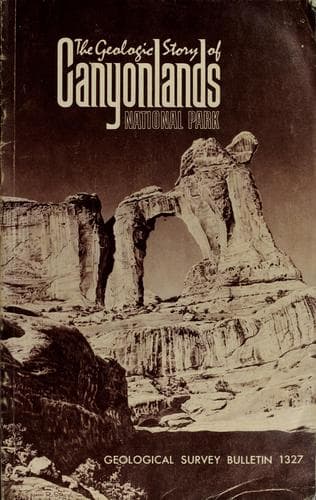
The Geologic Story of Canyonlands National ParkLohman, Stanley William
Science
The Geologic Story of Canyonlands National Park
Lohman, Stanley William
Canyonlands National Park (Utah) -- Guidebooks; Geology -- Utah -- Canyonlands National Park -- Guidebooks
In the spring of 1972, a 93-foot 150-passenger stern-wheeler (fig. 69)
began passenger service on the Colorado River from just above Potash to
the foot of Dead Horse Point and return (Lansford, 1972).
Entrenched and cutoff meanders
Meanders such as those above the confluence generally are formed by
streams flowing in soft alluvium consisting of clay, silt, and sand,
such as along the Mississippi River below Cairo, Ill. But there is no
soft alluvium along the Colorado and Green Rivers, so how did these
meanders form? They probably attained their serpentine shape while
cutting in softer, younger material, which long ago was removed by
erosion, and then continued to cut their crooked channels down, until
they created the deep rock-walled canyons in which they now flow as
“entrenched” meanders.
Meandering streams tend to shorten their lengths from time to time by
cutting through narrow walls between adjacent loops, leaving abandoned
horseshoe-shaped channels or lakes. In most of the United States these
are known as oxbows or cutoff meanders, but in the desert Southwest they
are commonly called by the Spanish term “rincon.” Cutoffs are common
along soft alluvial channels such as the lower Mississippi River valley
but are rare along channels whose meanders are entrenched into hard
rock. Thus, there have been many natural (and several manmade) cutoffs
along the lower Mississippi during historic times, but the most recent
ones along the Green and upper Colorado Rivers probably occurred a
million or so years ago, during the Pleistocene Epoch (figs. 65, 80).
Mark Twain served several years as an expert riverboat pilot on the
Mississippi River during which several cutoffs took place. Chapter 27 of
his “Life on the Mississippi” contains sage references to both natural
and artificial cutoffs and concludes with a few good-natured jibes at
geologists in particular and scientists in general:
Therefore the Mississippi between Cairo and New Orleans was twelve
hundred and fifteen miles long one hundred and seventy six years ago.
It was eleven hundred and eighty after the cutoff of 1722. It was one
thousand and forty after the American Bend cut-off. It has lost
sixty-seven miles since. Consequently, its length is only nine hundred
and seventy-three miles at present.
Now, if I wanted to be one of those ponderous scientific people, and
“let on” to prove what had occurred in the remote past by what had
occurred in a given time in the recent past, or what will occur in the
far future by what has occurred in late years, what an opportunity is
here! Geology never had such a chance, nor such exact data to argue
from! Nor “development of species,” either! Glacial epochs are great
things, but they are vague—vague. Please observe:
Public-domain text, read in full here on John Shaqi.
Reviews
Reviews
No reviews yet
Be the first to share your thoughts on this work.
Elsewhere in the archive
Join the Discussion
Join the discussion
Sign in to leave a comment or review.
Sign InorCreate an account