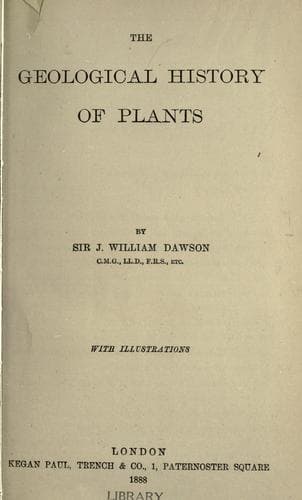
The Geological History of PlantsDawson, John William, Sir
Science
The Geological History of Plants
Dawson, John William, Sir
Paleobotany
I would add to this only one further consideration. The nitrogen
present in the _Lycopodium_ spores, no doubt, belongs to the protoplasm
contained in them, a substance which would soon perish by decay; and
subtracting this, the cell-walls of the spores and the walls of the
spore-cases would be most suitable material for the production of
bituminous coal. But this suitableness they share with the epidermal
tissue of the scales of strobiles, and of the stems and leaves of ferns
and lycopods, and, above all, with the thick, corky envelope of the
stems of _Sigillariæ_ and similar trees, which, as I have elsewhere
shown,[CM] from its condition in the prostrate and erect trunks contained
in the beds associated with coal, must have been highly carbonaceous
and extremely enduring and impermeable to water. In short, if, instead
of "spore-cases," we read "epidermal tissues in general, including
spore-cases," all that has been affirmed regarding the latter will
be strictly and literally true, and in accordance with the chemical
composition, microscopical characters, and mode of occurrence of coal. It
will also be in accordance with the following statement, from my paper on
the "Structures in Coal," published in 1859:
[CM] "Vegetable Structures in Coal," "Journal of Geological Society,"
xv., 626. "Conditions of Accumulation of Coal," _ibid._, xxii., 95.
"Acadian Geology," 197, 464.
"A single trunk of _Sigillaria_ in an erect forest presents an epitome of
a coal-seam. Its roots represent the _Stigmaria_ under-clay; its bark the
compact coal; its woody axis the mineral charcoal; its fallen leaves (and
fruits), with remains of herbaceous plants growing in its shade, mixed
with a little earthy matter, the layers of coarse coal. The condition of
the durable outer bark of erect trees concurs with the chemical theory
of coal, in showing the especial suitableness of this kind of tissue for
the production of the purer compact coals. It is also probable that the
comparative impermeability of the bark to mineral infiltration is of
importance in this respect, enabling this material to remain unaffected
by causes which have filled those layers, consisting of herbaceous
materials and decayed wood, with pyrites and other mineral substances."
Public-domain text, read in full here on John Shaqi.
Reviews
Reviews
No reviews yet
Be the first to share your thoughts on this work.
Elsewhere in the archive
Join the Discussion
Join the discussion
Sign in to leave a comment or review.
Sign InorCreate an account