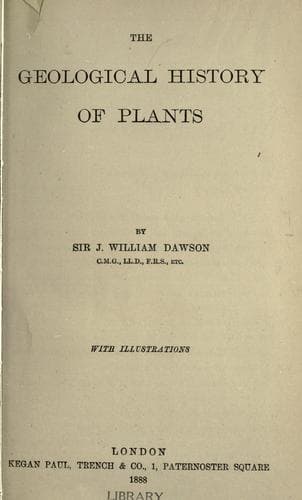
The Geological History of PlantsDawson, John William, Sir
Science
The Geological History of Plants
Dawson, John William, Sir
Paleobotany
In recent reports on the Tertiary floras of Australia and New
Zealand,[DY] Ettingshausen holds that the flora of the Tertiary, as a
whole, was of a generalised character; forms now confined to the southern
and northern hemispheres respectively being then common to both. It would
thus seem that the present geographical diversities must have largely
arisen from the great changes in climate and distribution of land and
water in the later Tertiary.
[DY] "Geological Magazine," August, 1887.
The length of our discussion of the early angiospermous flora does not
permit us to trace it in detail through the Miocene and Pliocene, but
we may notice the connection through these in the next chapter, and may
refer to the magnificent publications of Heer and Lesquereux on the
Tertiary floras of Europe and America respectively.
CHAPTER VII.
PLANTS FROM THE TERTIARY TO THE MODERN PERIOD.
It may be well to begin this chapter with a sketch of the general
physical and geological conditions of the period which was characterised
by the advent and culmination of the dicotyledonous trees.
In the Jurassic and earliest Cretaceous periods the prevalence, over the
whole of the northern hemisphere and for a long time, of a monotonous
assemblage of gymnospermous and acrogenous plants, implies a uniform and
mild climate, and facility for intercommunication in the north. Toward
the end of the Jurassic and beginning of the Cretaceous, the land of the
northern hemisphere was assuming greater dimensions, and the climate
probably becoming a little less uniform. Before the close of the Lower
Cretaceous period the dicotyledonous flora seems to have been introduced,
under geographical conditions which permitted a warm temperate climate to
extend as far north as Greenland.
In the Cenomanian or Middle Cretaceous age we find the northern
hemisphere tenanted with dicotyledonous trees closely allied to those of
modern times, though still indicating a climate much warmer than that
which at present prevails. In this age, extensive but gradual submergence
of land is indicated by the prevalence of chalk and marine limestones
over the surface of both continents; but a circumpolar belt seems to
have been maintained, protecting the Atlantic and Pacific basins from
floating ice, and permitting a temperate flora of great richness to
prevail far to the north, and especially along the southern margins and
extensions of the circumpolar land. These seem to have been the physical
conditions which terminated the existence of the old Mesozoic flora and
introduced that of the Middle Cretaceous.
As time advanced the quantity of land gradually increased, and the
extension of new plains along the older ridges of land was coincident
with the deposition of the great Laramie series, and with the origination
of its peculiar flora, which indicates a mild climate and considerable
variety of station in mountain, plain, and swamp, as well as in great
sheets of shallow and weedy fresh water.
Public-domain text, read in full here on John Shaqi.
Reviews
Reviews
No reviews yet
Be the first to share your thoughts on this work.
Elsewhere in the archive
Join the Discussion
Join the discussion
Sign in to leave a comment or review.
Sign InorCreate an account