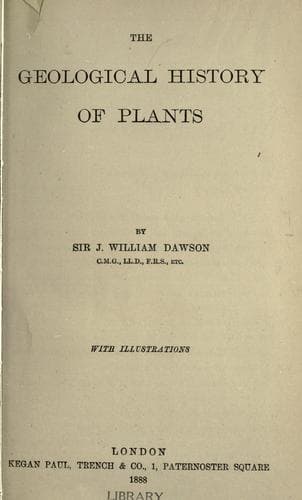
The Geological History of PlantsDawson, John William, Sir
Science
The Geological History of Plants
Dawson, John William, Sir
Paleobotany
"Only one species (_Trapa natans_, Willd.) has disappeared from our
islands. Its fruits, which Mr. Reid found abundantly in one locality,
agree with those of the plants found until recently in the lakes of
Sweden. Four species (_Prunus speciosa_, L., _[OE]nanthe Tichenalii_,
Sm., _Potamogeton pterophyllus_, Sch., and _Pinus abies_, L.) are found
at present only in Europe, and a fifth (_Potamogeton trichoides_, Cham.)
extends also to North America; two species (_Peucedanum palustre_,
Moench, and _Pinus sylvestris_, L.) are found also in Siberia, while six
more (_Sanguisorba officinalis_, L., _Rubus fruticosus_, L., 5 _Cornus
sanguinea_, L., _Euphorbia amygdaloides_, L., _Quercus robur_, L., and
_Potamogeton crispus_, L.) extend into western Asia, and two (_Fagus
sylvatica_, L., and _Alnus glutinosa_, L.) are included in the Japanese
flora. Seven species, while found with the others, enter also into the
Mediterranean flora, extending to North Africa: these are _Thalictrum
minus_, L., _Thalictrum flavum_, L., _Ranunculus repens_, L., _Stellaria
aquatica_, Scop., _Corylus avellana_, L., _Yannichellia palustris_, L.,
and _Cladium mariscus_, Br. With a similar distribution in the Old World,
eight species (_Bidens tripartita_, L., _Myosotis cæspitosa_, Schultz,
_Suæda maritima_, Dum., _Ceratophyllum demersum_,, L., _Sparganium
ramosum_, Huds., _Potamogeton pectinatus_, L., _Carex paludosa_, Good.,
and _Osmunda regalis_, L.) are found also in North America. Of the
remainder, ten species (_Nuphar luteum_, Sm., _Menyanthes trifoliata_,
L., _Stachys palustris_, L., _Rumex maritimus_, L., _Rumex acetosella_,
L., _Betula alba_, L., _Scirpus pauciflorus_, Lightf., _Taxus baccata_,
L., and _Isoetes lacustris_, L.) extend round the north temperate
zone, while three (_Lycopus europæus_, L., _Alisma plantago_, L., and
_Phragmites communis_, Trim), having the same distribution in the north,
are found also in Australia, and one (_Hippuris vulgaris_, L.) in the
south of South America. The list is completed by _Ranunculus aquatilis_,
L., distributed over all the temperate regions of the globe, and _Scirpus
lacustris_, L., which is found in many tropical regions as well."
He remarks that these plants, while including species now very widely
scattered, present no appreciable change of characters.
Above this bed are glacial clays, which hold other species indicating an
extremely cold climate. They are few in number, only _Salix polaris_, a
thoroughly arctic species, and its ally, _S. cinerea_, L., and a moss,
_Hypnum turgescens_, Schimp., no longer found in Britain, but an Alpine
and arctic species. This bed belongs to the beginning of the Glacial
period, the deposits of which have as yet afforded no plants in England.
But plants occur in post-glacial and upper-glacial beds in different
parts of England, to which Carruthers thus refers:
Public-domain text, read in full here on John Shaqi.
Reviews
Reviews
No reviews yet
Be the first to share your thoughts on this work.
Elsewhere in the archive
Join the Discussion
Join the discussion
Sign in to leave a comment or review.
Sign InorCreate an account