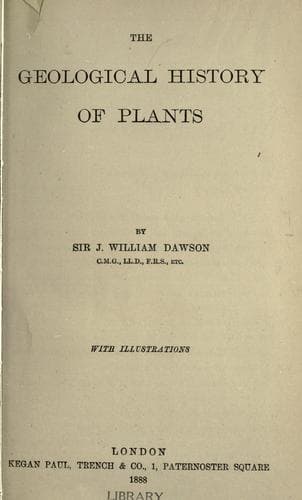
The Geological History of PlantsDawson, John William, Sir
Science
The Geological History of Plants
Dawson, John William, Sir
Paleobotany
These changes need not have required a very long time, for the
multiplication and migration of plants are very rapid, especially when
aided by the agency of migratory animals. Many parts of the land must,
indeed, have been stocked with plants from various sources, and by
agencies--as that of the sea--which might at first sight seem adverse to
their distribution. The British Islands, for example, have no indigenous
plants. Their flora consists mainly of Germanic plants, which must have
migrated to Britain in that very late period of the Post-glacial when
the space now occupied by the North Sea was mostly dry land. Other
portions of it are Scandinavian plants, perhaps survivors of the Glacial
age, or carried by migratory birds; and still another element consists
of Spanish plants, brought north by spring migrants, and establishing
themselves in warm and sheltered spots, just as the arctic plants do on
the bleak hill-tops. The Bermudas, altogether recent islands, have one
hundred and fifty species of native plants, all of which are West Indian
and American, and must have been introduced by the sea-currents or by
migratory birds.
And so the earth became fitted for the residence of modern man. Yet it is
not so good or Edenic a world as it once was, or as it may yet become,
were another revolution to restore a mild climate to the arctic regions,
and to send down a new swarm of migratory species to renew the face of
the earth and restore it to its pristine fertility of vegetable life.
Thus closes this long history of the succession of plants, reaching
from the far back Laurentian to the present day. It has, no doubt, many
breaks, and much remains to be discovered. Yet it may lead us to some
positive conclusions regarding the laws of the introduction of plants.
Public-domain text, read in full here on John Shaqi.
Reviews
Reviews
No reviews yet
Be the first to share your thoughts on this work.
Elsewhere in the archive
Join the Discussion
Join the discussion
Sign in to leave a comment or review.
Sign InorCreate an account