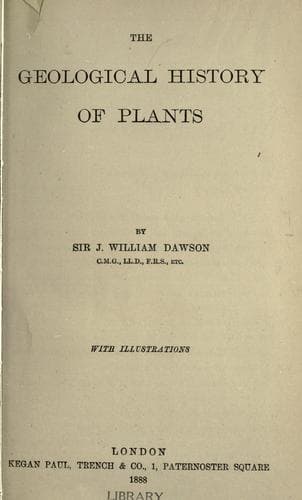
The Geological History of PlantsDawson, John William, Sir
Science
The Geological History of Plants
Dawson, John William, Sir
Paleobotany
What we have learned respecting this wonderful history has served
strangely to change some of our preconceived ideas. We must now be
prepared to admit that an Eden can be planted even in Spitzbergen, that
there are possibilities in this old earth of ours which its present
condition does not reveal to us; that the present state of the world is
by no means the best possible in relation to climate and vegetation; that
there have been and might be again conditions which could convert the
ice-clad arctic regions into blooming paradises, and which at the same
time would moderate the fervent heat of the tropics. We are accustomed to
say that nothing is impossible with God; but how little have we known of
the gigantic possibilities which lie hidden under some of the most common
of his natural laws!
These facts have naturally been made the occasion of speculations as
to the spontaneous development of plants by processes of varietal
derivation. It would, from this point of view, be a nice question to
calculate how many revolutions of climate would suffice to evolve the
first land-plant; what are the chances that such plant would be so
dealt with by physical changes as to be preserved and nursed into a
meagre flora like that of the Upper Silurian or the Jurassic; how many
transportations to Greenland would suffice to promote such meagre flora
into the rich and abundant forests of the Upper Cretaceous, and to
people the earth with the exuberant vegetation of the early Tertiary.
Such problems we may never be able to solve. Probably they admit of no
solution, unless we invoke the action of an Almighty mind, operating
through long ages, and correlating with boundless power and wisdom
all the energies inherent in inorganic and organic nature. Even then
we shall perhaps be able to comprehend only the means by which, after
specific types have been created, they may, by the culture of their
Maker, be "sported" into new varieties or subspecies, and thus fitted
to exist under different conditions or to occupy higher places in the
economy of nature.
Before venturing on such extreme speculations as some now current on
questions of this kind, we would require to know the successive extinct
floras as perfectly as those of the modern world, and to be able to
ascertain to what extent each species can change either spontaneously
or under the influence of struggle for existence or expansion under
favourable conditions, and under arctic semi-annual days and nights, or
the shorter days of the tropics. Such knowledge, if ever acquired, it may
take ages of investigation to accumulate.
Public-domain text, read in full here on John Shaqi.
Reviews
Reviews
No reviews yet
Be the first to share your thoughts on this work.
Elsewhere in the archive
Join the Discussion
Join the discussion
Sign in to leave a comment or review.
Sign InorCreate an account